Summary
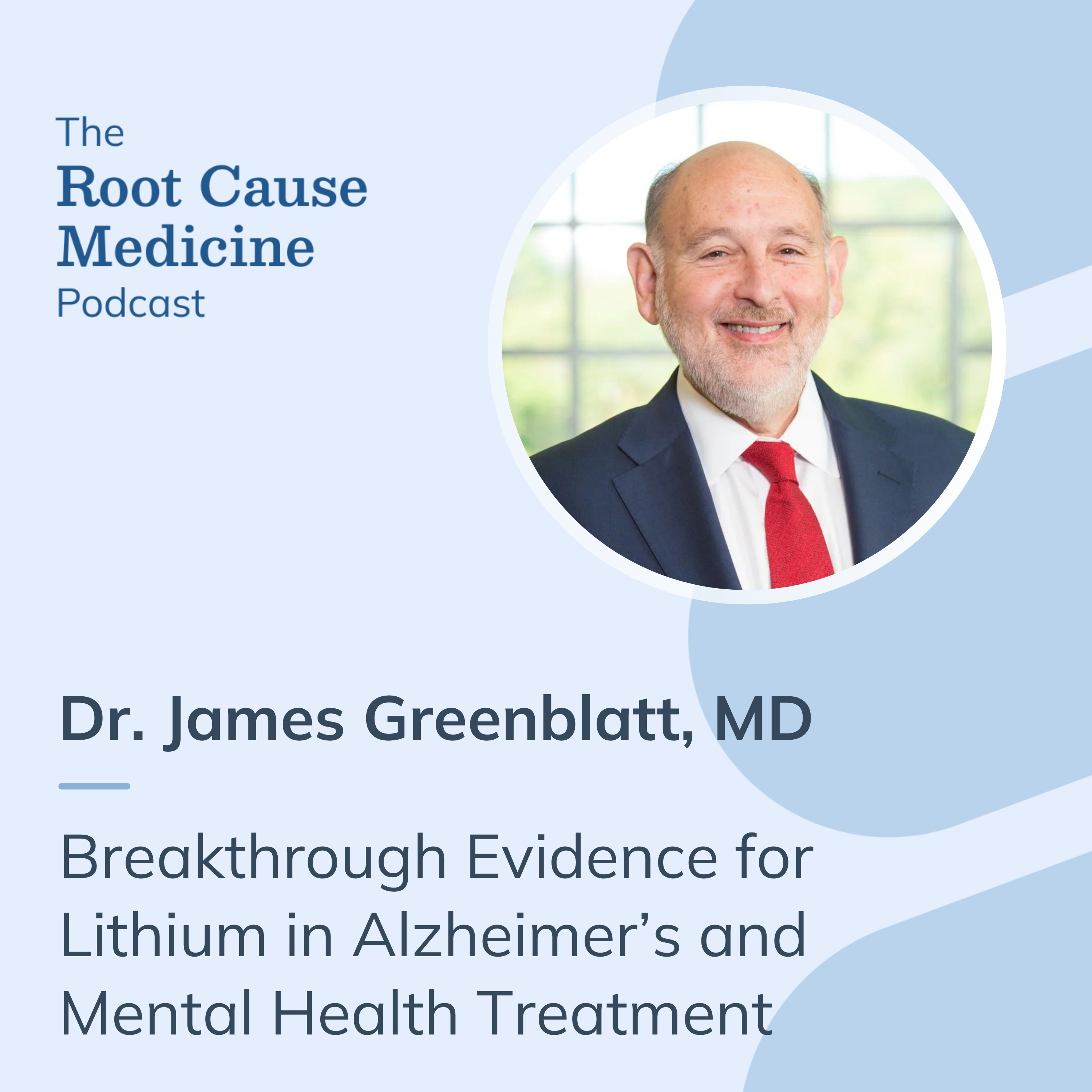
Dr. Kate Kresge and integrative psychiatrist Dr. James Greenblatt discuss a landmark Harvard paper showing that lithium is naturally present in the brain and gets depleted early in Alzheimer's disease. They cover how low-dose lithium orotate may restore brain levels, reverse memory loss in animal models, and why even trace amounts of lithium in drinking water correlate with lower rates of dementia and suicide.
Key Points
- A Harvard Nature paper showed lithium is naturally present in the brain and gets depleted early in Alzheimer's as it binds to amyloid plaques.
- Lithium orotate at 2-10mg can restore brain lithium levels in animal models and has reversed memory loss in Alzheimer's-prone mice.
- Trace lithium in drinking water correlates with lower rates of dementia, suicide, and aggression across population-level studies.
- Lithium orotate at low doses (2-10mg) has a very different risk profile from lithium carbonate (1200-1800mg) used in bipolar treatment.
- Lithium is an essential mineral that supports neuroplasticity, reduces neuroinflammation, and protects against oxidative stress in the brain.
- Kidney and thyroid risks associated with lithium are primarily concerns at psychiatric doses (lithium carbonate), not nutritional doses (lithium orotate).
Key Moments
Harvard paper reveals lithium depletion in Alzheimer's brains
Dr. Greenblatt explains that a landmark Harvard paper published in Nature confirmed lithium is essential for brain function, that lithium orotate can prevent cognitive decline, and can even reverse some neuropathology of dementia.
"And even before I was practicing psychiatry. And I've been prescribing the lithium orotate that they talked about for 30 years. But what this paper did, published in Nature, the most reputable science magazine from a group of researchers at Harvard, which always helps, they established some..."
Lithium orotate escapes amyloid plaque sequestration
The Harvard researchers found that amyloid plaques scavenge lithium from the brain, but lithium orotate uniquely escapes sequestration due to its charge, making it more effective than lithium carbonate at restoring brain levels.
"But lithium orotate managed to really escape being sequestered by these plaques because of how it's charged."
Low-dose lithium orotate protocol for clinical use
Dr. Greenblatt describes using 2 to 10 milligrams of lithium orotate as a nutraceutical, noting it is close to physiologic doses and rarely causes side effects compared to the 1800 milligram pharmaceutical lithium carbonate dose.
"And then the area of my career and what this article can kind of help support is lithium as a nutraceutical. And those dosages are, I'm recommending, like between 2 and 10 milligrams. And I think the most important thing for people to understand is that lithium is an essential mineral. And we get a couple milligrams in our diet every day."
Lithium inhibits GSK3 enzyme to reduce neuroinflammation
Dr. Greenblatt explains that lithium inhibits the GSK3 enzyme, a core mechanism by which it reduces neuroinflammation in the brain, relevant to conditions from Alzheimer's to traumatic brain injury to depression.
"So it has this kind of neuroregenerative property. And again, 20 plus years of knowledge. The one that's getting a lot of press now, which I remember reading about years ago, is lithium inhibits this enzyme called GSK3. And GSK3 causes inflammation in the brain. And lithium inhibits that."