
Key Takeaway
PMA-zeolite supplementation significantly decreased nickel, aluminum, and arsenic blood levels across three clinical trials, but may reduce beneficial minerals like sodium and calcium in long-term use.
Summary
This study evaluated the effects of defined PMA-zeolite (clinoptilolite) supplementation on mineral and contaminant blood levels across three controlled clinical trials with different durations: 28 days, 12 weeks, and 4 years.
Results showed that nickel and aluminum levels significantly decreased after 4-year supplementation (p < 0.001), and arsenic decreased significantly after 12 weeks. Lead levels initially rose but normalized with continued use. However, copper, sodium, and calcium dropped below reference values in osteoporosis patients on long-term supplementation, raising concerns about essential mineral depletion.
The authors recommend monitoring mineral balance after one year in patients receiving zeolite supplementation, particularly those with osteoporosis. No aluminum or lead leakage from the zeolite itself was detected one hour post-intake in the short-term trial.
Methods
- Three controlled clinical trials of varying durations (28 days, 12 weeks, 4 years)
- Short-term (MMBP study): 28-day supplementation with blood draws at 1 hour post-intake
- Medium-term (Morbus Crohn study): 12-week supplementation in patients with Crohn's disease
- Long-term (Osteoporosis TOP study): 4-year supplementation in osteoporosis patients
- Blood mineral and contaminant analysis via ICP-MS (inductively coupled plasma mass spectrometry)
- Statistical significance threshold p < 0.05
Key Results
- Nickel and aluminum significantly decreased after 4-year supplementation (p < 0.001)
- Arsenic significantly decreased after 12 weeks of supplementation
- Lead initially elevated in short and medium-term trials, then normalized with continued use
- Copper decreased in osteoporosis patients on long-term use
- Sodium and calcium fell below reference ranges in long-term osteoporosis group
- No aluminum or lead leakage detected 1 hour post-intake in the short-term trial
Figures
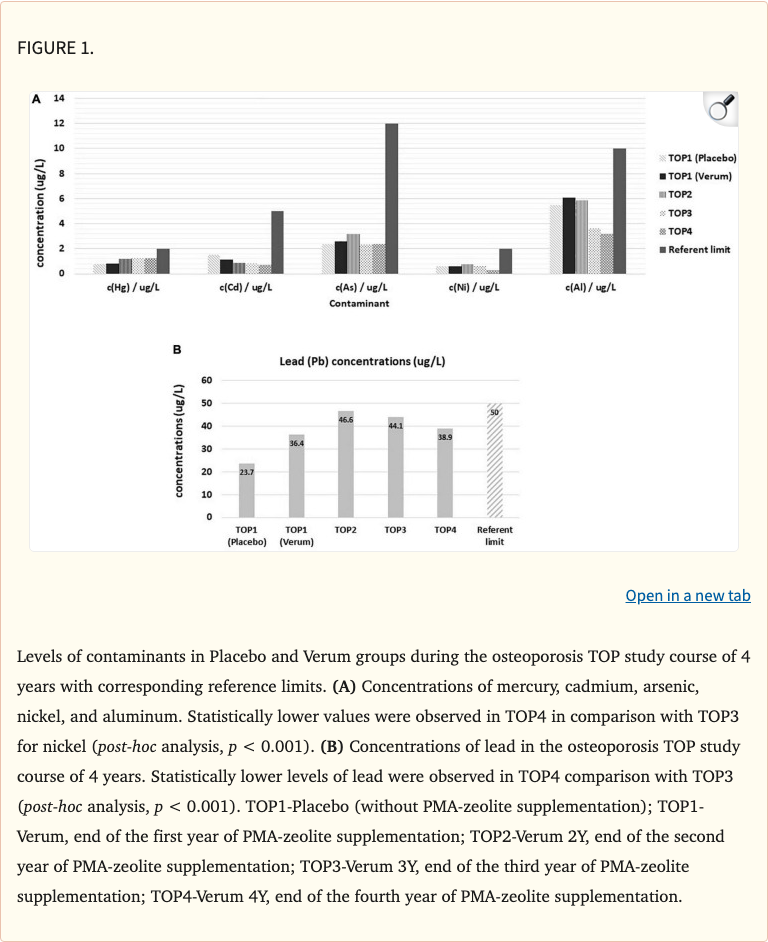 Figure 1
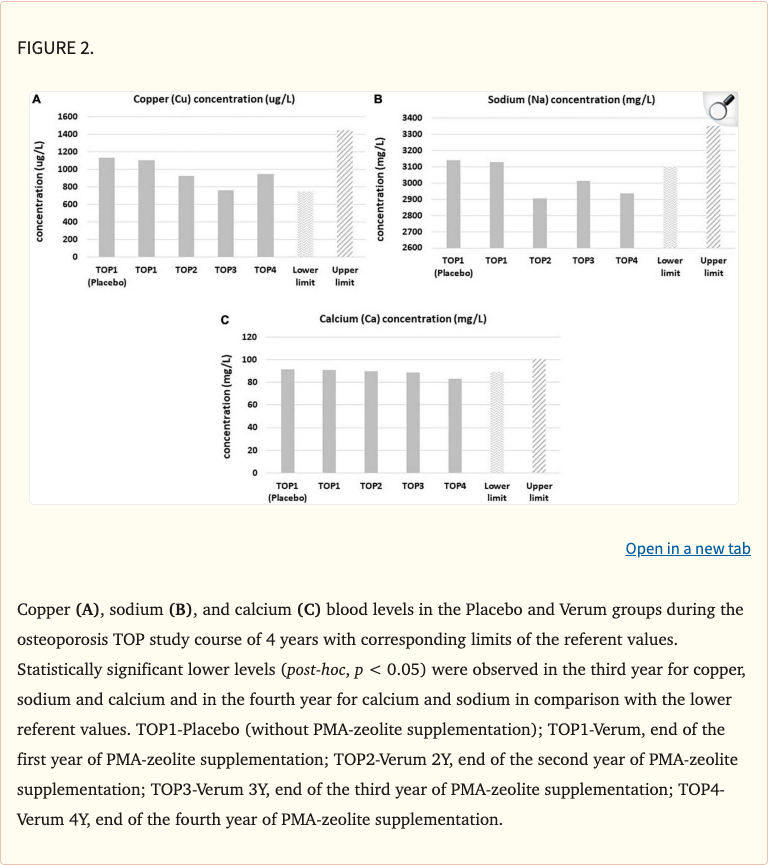 Figure 2
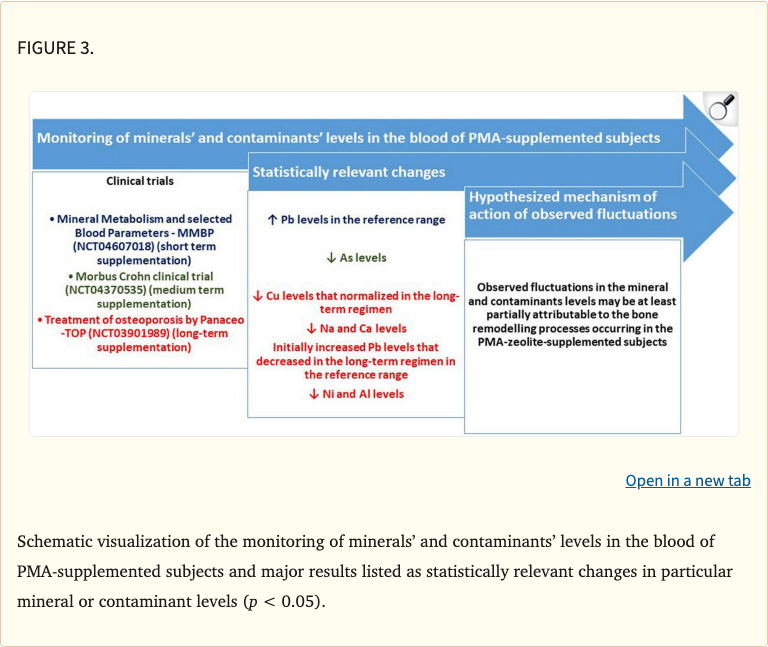 Figure 3
Limitations
- Sample sizes not clearly reported across all three trials
- Different patient populations in each trial (healthy, Crohn's, osteoporosis)
- No unified placebo-controlled design across all trials
- Long-term trial limited to osteoporosis patients, reducing generalizability
- Initial lead elevation raises questions about short-term safety
- Industry involvement (PMA-zeolite is a defined commercial product)