
Key Takeaway
Non-exercise activity thermogenesis (NEAT) varies dramatically between individuals and may be a major factor in obesity resistance.
Summary
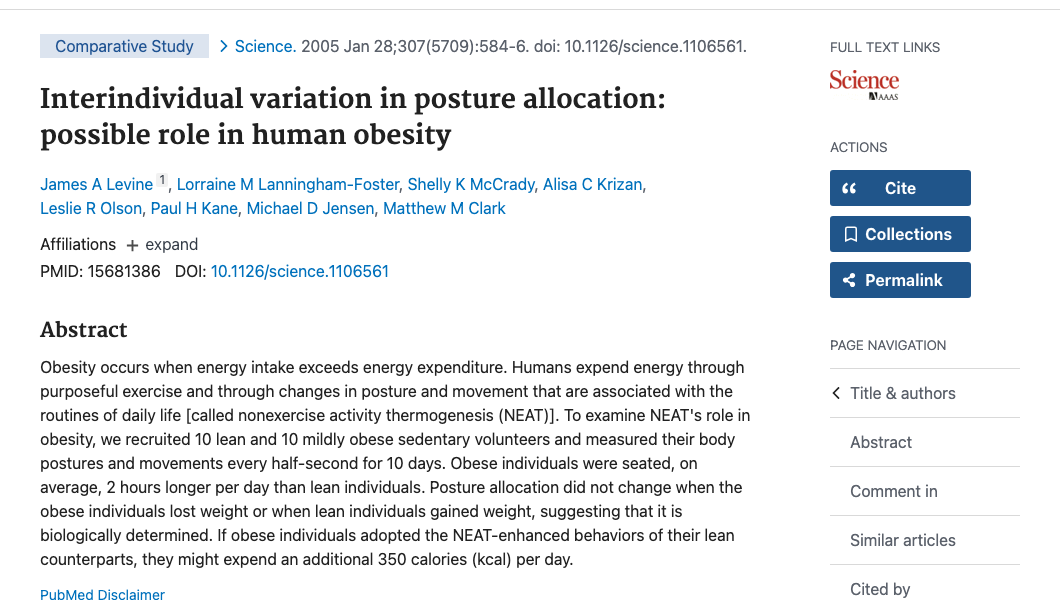
This landmark study by James Levine measured posture and movement in lean and obese individuals using sophisticated sensing technology. The researchers found that obese participants sat an average of 2.5 hours more per day than lean participants.
The difference in NEAT (non-exercise activity thermogenesis) between groups amounted to approximately 350 calories per day. When obese participants lost weight, they did not increase their movement; when lean participants gained weight, they did not decrease movement - suggesting NEAT may be biologically regulated.
This foundational research established that unconscious daily movement is a major factor in energy balance and weight regulation.
Methods
- Sophisticated posture/movement sensors
- 10-day continuous monitoring
- Lean vs obese participants
- Controlled feeding conditions
Key Results
- Obese sat 2.5 hours/day more than lean
- ~350 calorie/day difference in NEAT
- NEAT did not change with weight change
- Suggests biological regulation of movement
Limitations
- Small sample size
- Short monitoring period
- Cannot prove causation