
Key Takeaway
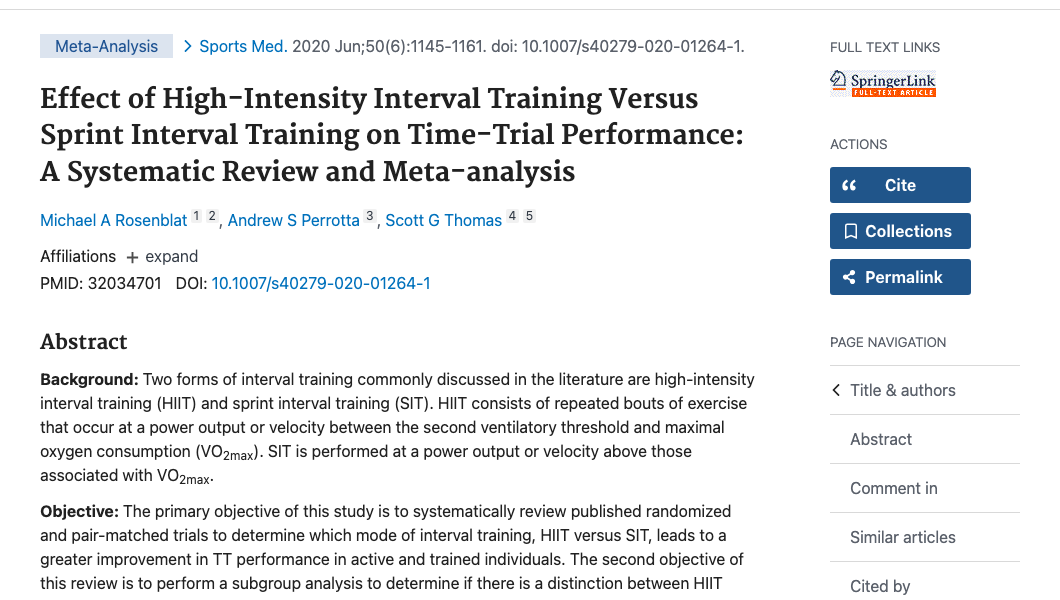
HIIT and SIT produce nearly identical time-trial performance improvements (0.9% difference), but HIIT shows a moderate advantage for maximal aerobic power (ES = 0.70), suggesting long-duration HIIT may be optimal for endurance events.
Summary
This systematic review and meta-analysis directly compared the effects of high-intensity interval training (HIIT) versus sprint interval training (SIT) on time-trial performance and related physiological outcomes. The distinction matters because HIIT typically uses longer intervals at sub-maximal intensity (e.g., 4 minutes at 85-95% HRmax), while SIT uses short all-out efforts (e.g., 30 seconds at maximum intensity).
The meta-analysis found no meaningful difference between HIIT and SIT for time-trial performance, with only a 0.9% difference between protocols. However, when examining maximal aerobic power (VO2max, peak power output), HIIT showed a moderate advantage with an effect size of 0.70. This suggests that while both approaches improve endurance performance similarly, HIIT may be superior for building peak aerobic capacity.
The authors concluded that long-duration HIIT protocols may be optimal for time-trial performance specifically, likely because the longer intervals more closely replicate the sustained high-intensity demands of time-trial events. SIT remains highly effective for overall fitness and anaerobic adaptations but may not confer additional endurance benefits beyond what HIIT provides.
Methods
Systematic review and meta-analysis comparing head-to-head HIIT versus SIT studies. HIIT was defined as intervals at sub-maximal intensity (< 100% VO2max) and SIT as all-out supramaximal efforts. Outcomes included time-trial performance, VO2max, and peak power output. Random-effects models calculated pooled effect sizes. Subgroup analyses examined interval duration and total training volume.
Key Results
- Time-trial performance: No significant difference between HIIT and SIT (0.9% difference)
- Maximal aerobic power: Moderate effect favoring HIIT (ES = 0.70)
- Long-duration HIIT intervals may be particularly effective for time-trial events
- SIT and HIIT produced comparable improvements in most cardiorespiratory outcomes
- Total training volume did not fully explain differences between protocols
Limitations
- Limited number of direct head-to-head comparison studies available
- Heterogeneity in how HIIT and SIT protocols were defined across studies
- Most studies used cycling; transferability to running or other modalities uncertain
- Training duration typically 4-12 weeks, limiting long-term conclusions
- Differences in total work done between HIIT and SIT complicate direct comparison
- Time-trial tests varied in duration and modality across studies