
Key Takeaway
Carrying loads increases energy expenditure proportionally to total mass - a 20 lb pack increases calorie burn by approximately 15-20% at walking speeds.
Summary
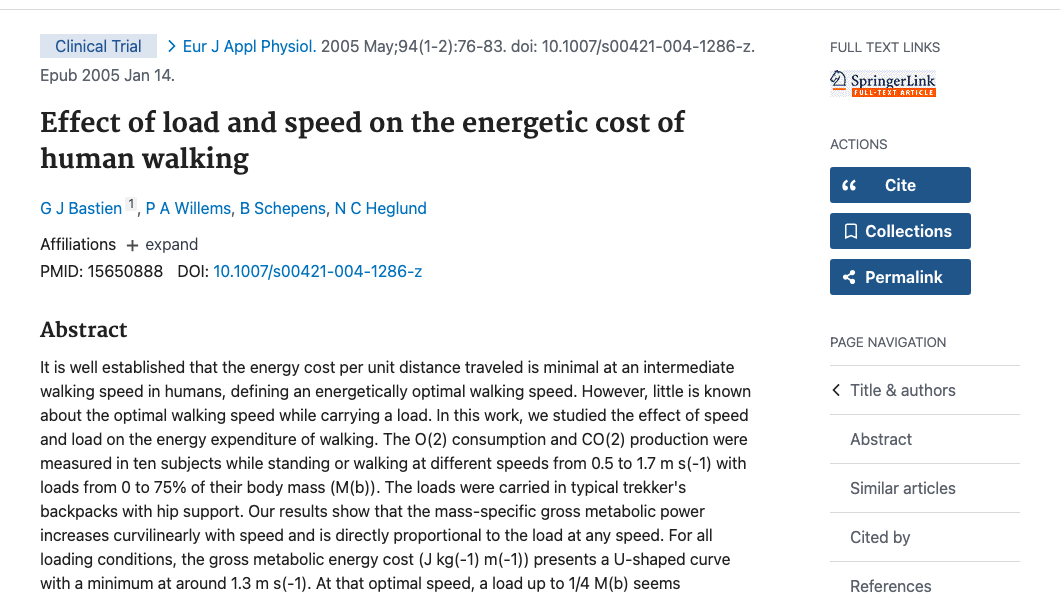
This study examined how carrying loads affects the metabolic cost of walking. Researchers measured oxygen consumption at various walking speeds with different load weights to establish the relationship between load, speed, and energy expenditure.
The key finding was that energy cost increases in proportion to total mass carried (body weight plus load). At typical walking speeds (3-4 mph), carrying 10 kg (~22 lbs) increased energy expenditure by approximately 15-20%.
This provides the physiological basis for why rucking burns more calories than regular walking while maintaining similar low-impact characteristics.
Methods
- Metabolic measurements during treadmill walking
- Various loads: 0, 7.5, 15, 30 kg
- Multiple walking speeds tested
- Oxygen consumption and CO2 production measured
Key Results
- Linear relationship between mass and energy cost
- 10 kg load increases cost ~15-20%
- Effect consistent across walking speeds
- Energy cost scales with total system mass
Limitations
- Laboratory treadmill conditions
- May differ on varied terrain
- Acute measurements only
- Did not assess training adaptations