
Key Takeaway
Buteyko breathing reduced beta-agonist inhaler use by 904 mcg/day and inhaled steroid use by 49%, with reduced minute ventilation but no change in objective lung function.
Summary
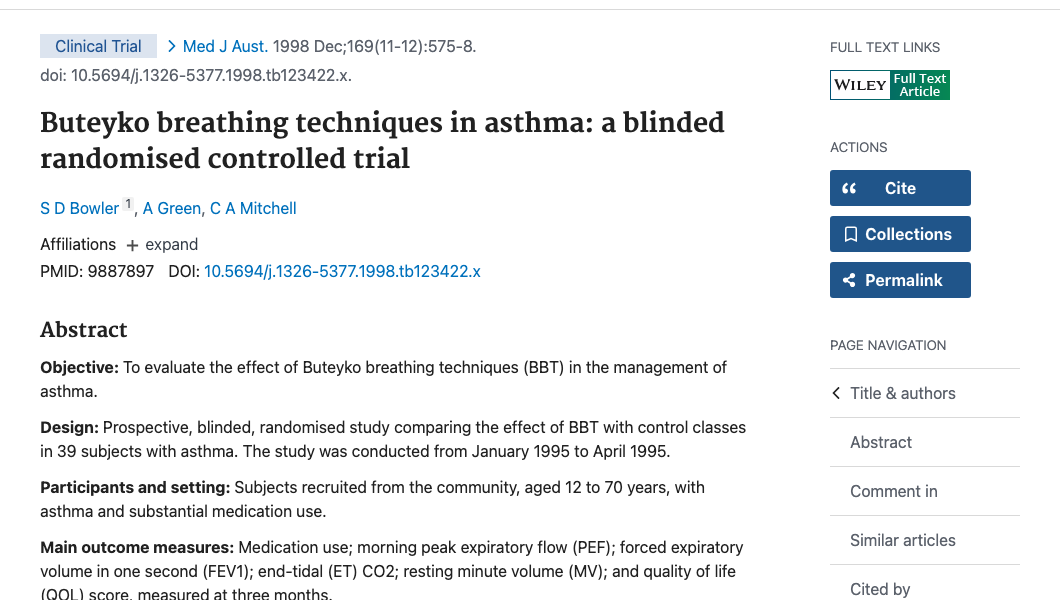
This blinded randomized controlled trial from Australia was one of the earliest rigorous evaluations of Buteyko breathing techniques (BBT) for asthma management. Thirty-nine asthmatics aged 12-70 were randomized to BBT training or control classes, with assessments of medication use, lung function, ventilation, and quality of life.
The BBT group achieved large, statistically significant reductions in reliever medication and a near-significant reduction in inhaled steroids, while also reducing minute ventilation. However, objective airway measurements (peak flow and FEV1) did not change in either group. The findings suggest Buteyko works primarily by reducing hyperventilation and medication dependence rather than by altering underlying airway physiology.
Methods
- 39 asthma patients aged 12-70 randomized to BBT or control
- Community-recruited participants requiring substantial medication
- Control group received standard asthma education classes
- Blinded assessment of outcomes
- Measured daily beta-agonist use, peak expiratory flow, FEV1, end-tidal CO2, resting minute ventilation
- Quality of life assessed at 3 months
- Study period: January-April 1995
Key Results
- BBT group reduced beta-agonist use by median 904 mcg/day vs 57 mcg in controls (P=0.002)
- 49% median reduction in inhaled steroids in BBT group vs no change in controls (P=0.06)
- BBT reduced minute ventilation significantly more than controls (P=0.004)
- No changes in daily peak expiratory flow or FEV1 in either group
- Trend toward improved quality of life favoring BBT (P=0.09)
Limitations
- Small sample size (n=39)
- Short follow-up period
- Cannot fully blind a behavioral intervention
- Community-recruited sample may not represent all asthma severities
- PubMed year (1999) differs from print publication (December 1998)