
Key Takeaway
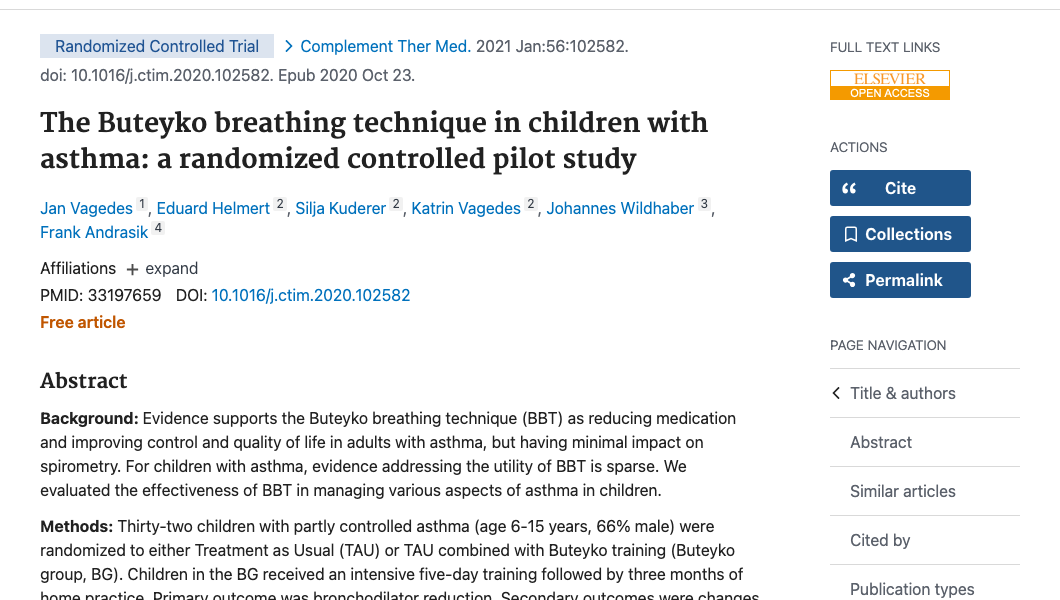
Buteyko breathing training improved lung function (FEV1) at rest and after exercise in children with asthma, though it did not reduce medication use over 3 months.
Summary
This randomized controlled pilot study was the first to evaluate Buteyko breathing technique specifically in children with asthma. Thirty-two children aged 6-15 with partially controlled asthma were randomized to treatment as usual (TAU) or TAU plus an intensive 5-day Buteyko training followed by 3 months of home practice.
While the primary outcome of bronchodilator reduction showed no significant between-group difference, the Buteyko group demonstrated significantly improved lung function (FEV1) both at rest and after exercise. Parents also reported significantly improved emotional function on quality-of-life measures. The study suggests Buteyko may have distinct benefits in pediatric populations, potentially improving airway function rather than just reducing medication dependence as seen in adult studies.
Methods
- 32 children aged 6-15 with partially controlled asthma
- 66% male participants
- Randomized to treatment as usual (TAU) or TAU plus Buteyko
- Buteyko group: intensive 5-day training followed by 3 months home practice
- Primary outcome: bronchodilator reduction
- Secondary outcomes: FEV1 at rest and after exercise, quality of life, corticosteroid use
- 3-month follow-up period
Key Results
- No significant between-group difference in bronchodilator reduction (primary outcome)
- Significantly improved FEV1 at rest in Buteyko group (P=0.04)
- Significantly improved FEV1 after exercise in Buteyko group (P=0.02)
- Significantly improved parental emotional function on quality-of-life measure (P<0.01)
- No significant differences in corticosteroid reduction or other parameters
Limitations
- Pilot study with small sample size (n=32)
- Short follow-up period (3 months)
- Cannot blind a behavioral intervention
- Pediatric population limits generalizability to adults
- Home practice adherence not objectively verified