
Key Takeaway
Practitioner-led vibroacoustic treatment produced the greatest improvements in disability, pain, and mood for chronic pain patients, while self-administered sessions maintained pain relief and relaxation benefits.
Summary
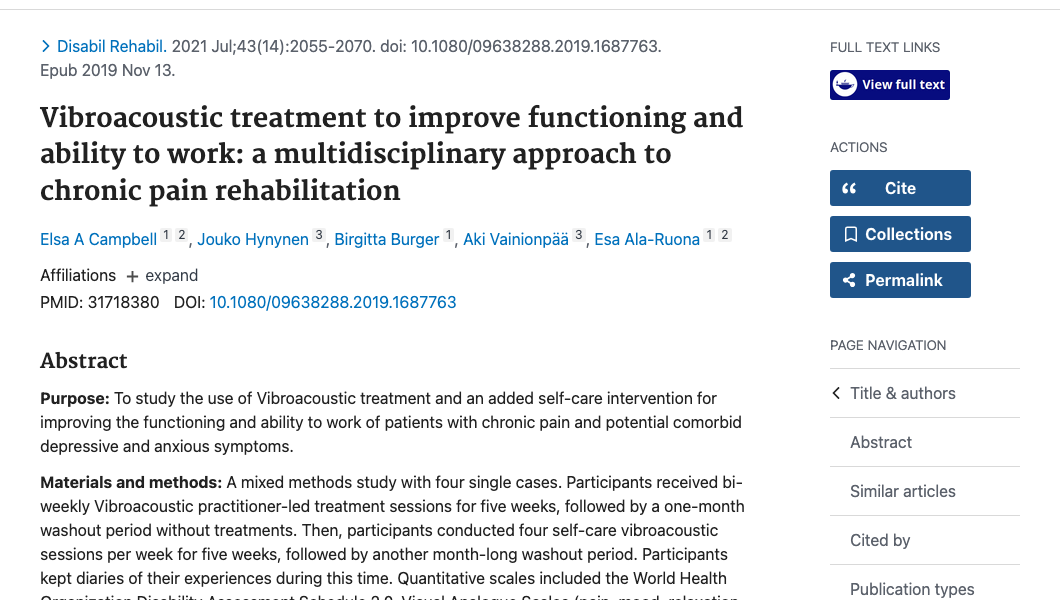
This mixed-methods study with four single cases examined vibroacoustic treatment combined with self-care interventions for chronic pain patients with potential comorbid depression and anxiety. The study used a phased design with practitioner-led sessions followed by self-administered treatment.
Results showed the greatest improvement from practitioner-led sessions, but self-care was also beneficial for pain relief and relaxation. Participants gained increased body awareness and better appreciated treatment effects during washout periods when symptoms returned, supporting vibroacoustic therapy as part of a multidisciplinary chronic pain rehabilitation approach.
Methods
- Mixed methods design with four single cases
- Phase 1: Bi-weekly practitioner-led sessions for 5 weeks
- Washout period of 1 month
- Phase 2: Self-administered sessions 4 times/week for 5 weeks
- Second washout period of 1 month
- Measured via WHO Disability Assessment Schedule 2.0, VAS, Beck's Depression Inventory-II, Hospital Anxiety and Depression Scale, plus participant diaries
Key Results
- Practitioner-led treatment produced the greatest improvements
- Self-care sessions maintained pain relief and relaxation
- Participants developed increased body awareness
- Treatment benefits became clearer during washout periods when symptoms returned
- Supported both practitioner-led and self-administered vibroacoustic approaches
Limitations
- Very small sample size (n=4 single cases)
- Limits generalizability and statistical power
- No control group
- Mixed-methods design makes causal claims difficult
- Self-care compliance not independently verified