
Key Takeaway
Low-frequency sound vibration significantly improved HRV parameters (LF/HF ratio and pNN50) compared to controls in stressed university students, indicating enhanced parasympathetic activity.
Summary
This pilot double-blinded RCT examined whether low-frequency sound vibration could reduce acute stress response in 54 university students. Participants were randomized to receive either vibroacoustic therapy (low-frequency sound combined with music) or a control condition.
Stress response was measured via heart rate variability (HRV), visual analogue scales for stress, and visual analogue scales for muscle relaxation. While both groups showed pre-to-post improvements, only HRV showed statistically significant between-group differences favoring the experimental group, particularly in sympathovagal balance metrics (LF/HF ratio and pNN50).
Methods
- Pilot double-blinded randomized controlled trial
- 54 international university students at a Czech summer school
- Individual randomization to vibroacoustic therapy or control
- Stress measured via HRV, VAS for stress, and VAS for muscle relaxation
Key Results
- Statistically significant between-group improvement in HRV (LF/HF ratio and pNN50)
- Pre-to-post improvements occurred in both groups
- Between-group differences emerged only for objective HRV measures
- Suggests shift toward parasympathetic dominance in the treatment group
Figures
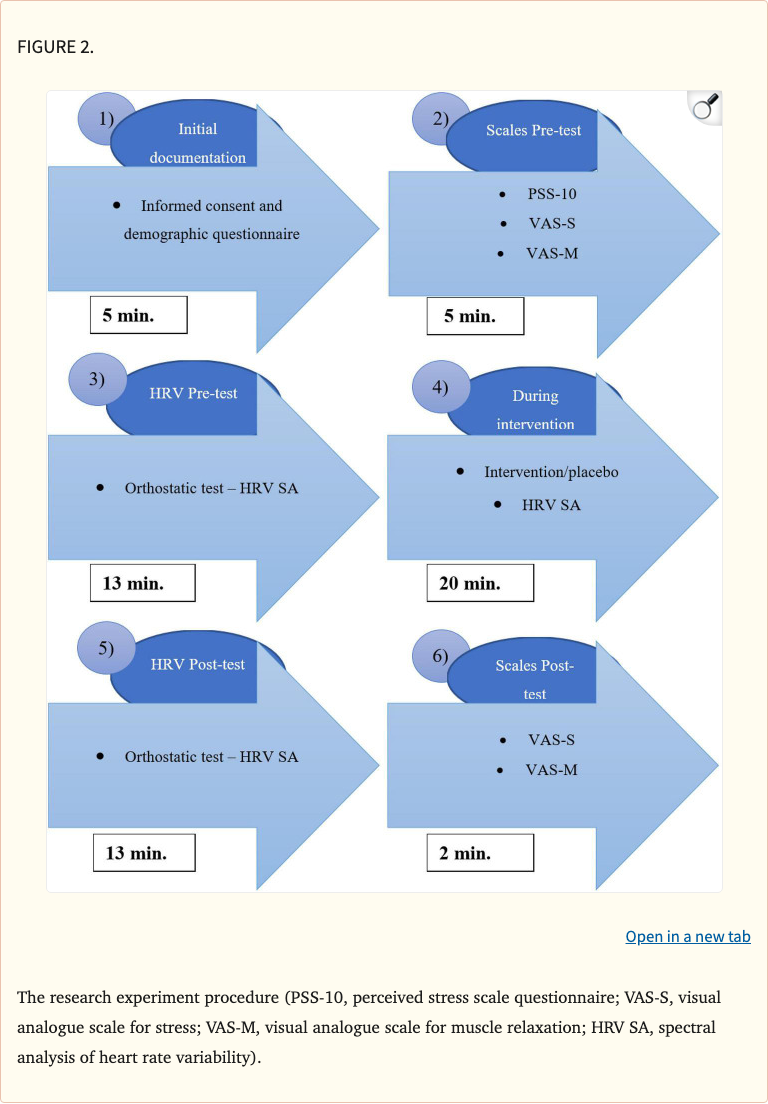 Figure 1
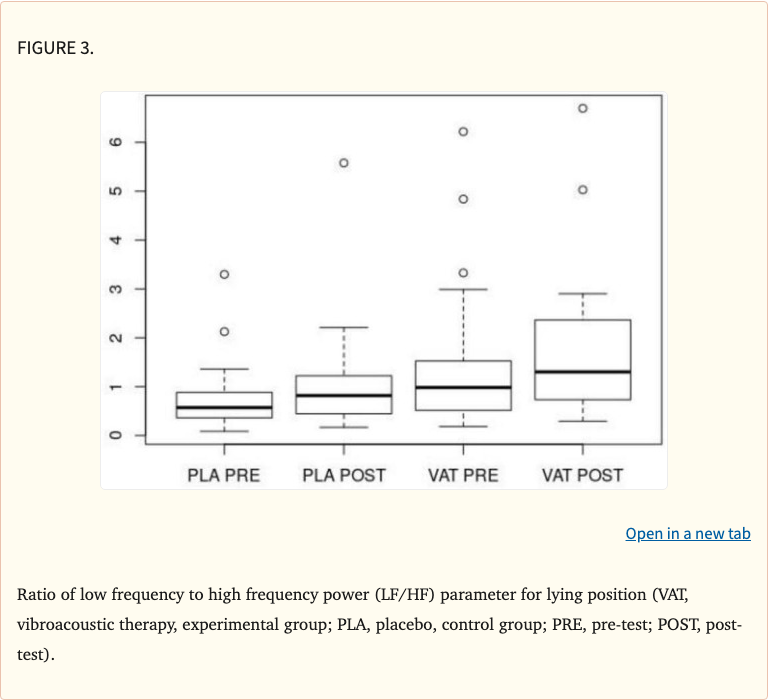 Figure 2
Limitations
- Pilot study with modest sample size (n=54)
- Effects of low-frequency sound not isolated from accompanying music
- Single session measured; no long-term follow-up
- Student population may not generalize to clinical settings