
Key Takeaway
HRV biofeedback produces large reductions in self-reported stress and anxiety, with pre-post effect size Hedges' g = 0.81 and between-groups g = 0.83 across 24 studies.
Summary
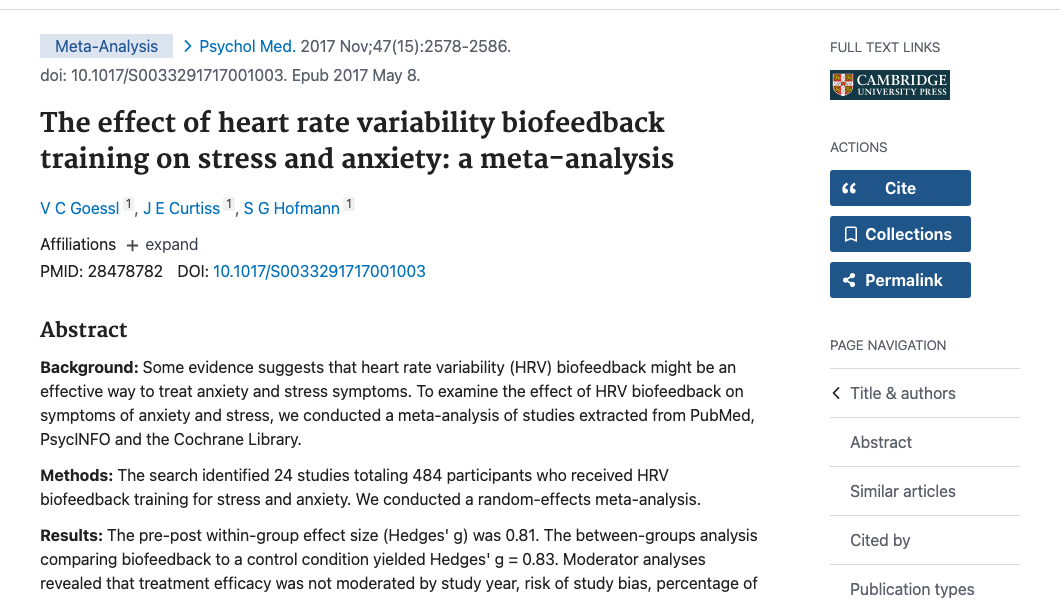
This meta-analysis examined the effectiveness of heart rate variability biofeedback (HRVB) training specifically for reducing stress and anxiety. The authors identified 24 studies with a total of 484 participants that met inclusion criteria.
The results showed robust effects of HRVB on stress and anxiety reduction. The pre-post effect size was Hedges' g = 0.81, indicating a large improvement from before to after HRVB training. The between-groups effect size comparing HRVB to control conditions was Hedges' g = 0.83, also in the large range. These findings suggest that HRVB is associated with meaningful reductions in self-reported stress and anxiety that go beyond simple passage of time or placebo effects.
The consistency of effects across different populations and study designs strengthens the case for HRVB as an evidence-based intervention for stress and anxiety management. The magnitude of effect sizes is comparable to established psychological interventions, suggesting HRVB could serve as a standalone or complementary treatment approach.
Methods
Systematic literature search across multiple databases for studies examining HRVB effects on stress and anxiety. Included 24 studies with 484 total participants. Calculated pre-post effect sizes (Hedges' g) and between-groups effect sizes comparing HRVB to control conditions. Assessed for publication bias and moderating variables.
Key Results
Pre-post effect size Hedges' g = 0.81 (large effect) for stress and anxiety reduction. Between-groups effect size Hedges' g = 0.83 (large effect) comparing HRVB to control conditions. Effects were consistent across different study designs and populations.
Limitations
Relatively small total sample size (484 participants across 24 studies). Many individual studies had small samples. Variability in HRVB protocols across studies. Self-reported outcomes subject to expectancy effects and demand characteristics. Limited long-term follow-up data to assess durability of effects.