Key Takeaway
The human circadian clock runs on a near-24-hour cycle and requires daily light exposure to stay synchronized with the external day-night cycle.
Summary
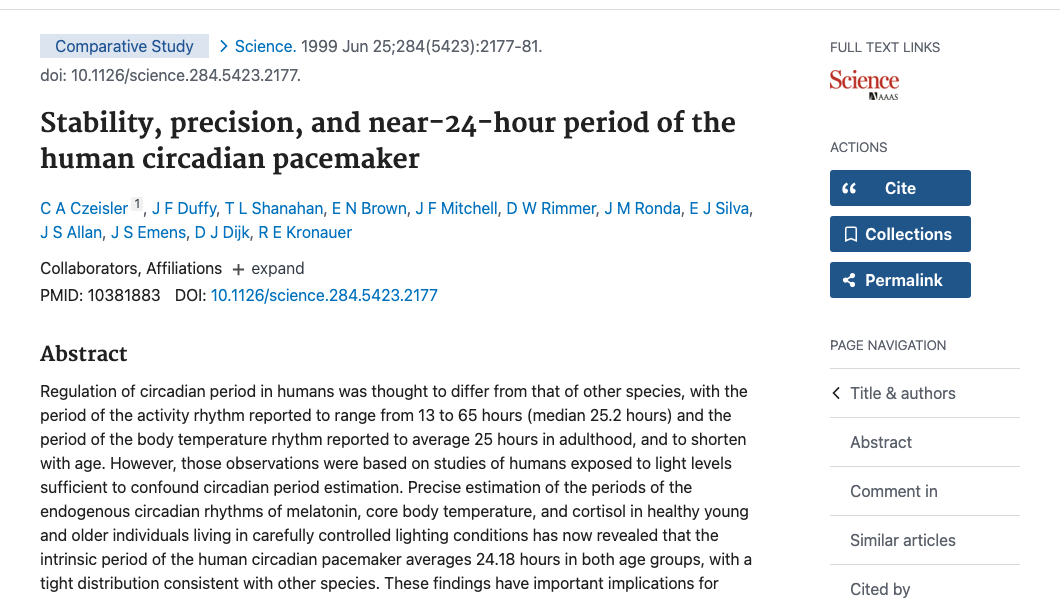
This landmark study precisely measured the intrinsic period of the human circadian pacemaker by studying people in controlled laboratory conditions without time cues. The researchers found that the average human circadian period is 24.18 hours - slightly longer than 24 hours.
This means that without daily light exposure to reset the clock, humans would gradually drift later and later, eventually becoming completely out of sync with day and night. The study demonstrated that light exposure is essential for keeping the circadian system aligned with the 24-hour day.
This foundational research explains why consistent morning light exposure is so important - it provides the daily reset signal that keeps our biology synchronized with the external world.
Methods
- Forced desynchrony protocol
- Controlled laboratory conditions
- Core body temperature measurements
- Melatonin rhythms
Key Results
- Average period: 24.18 hours
- Remarkably stable and precise
- Must be reset daily by light
- Individual variation exists
Limitations
- Highly controlled laboratory conditions
- Small sample size
- Young healthy adults only
Related Interventions
Related Studies
Discussed In