
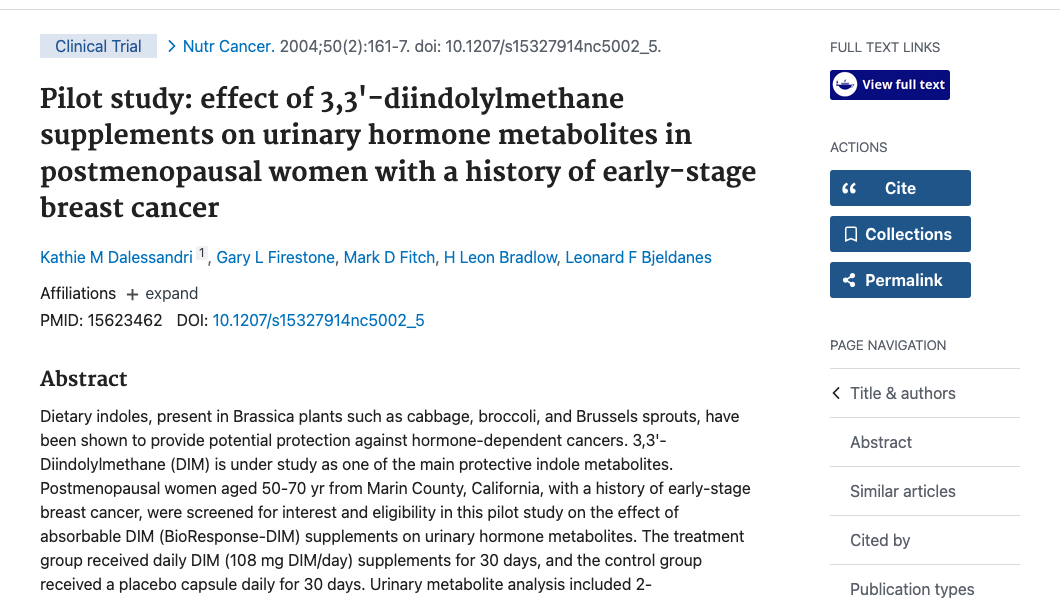
Key Takeaway
DIM supplementation significantly increases the 2-hydroxylation pathway of estrogen metabolism, shifting the ratio toward more protective metabolites.
Summary
This study examined the effects of DIM supplementation on estrogen metabolism in postmenopausal women.
Study design:
- Postmenopausal women participants
- DIM supplementation trial
- Measured urinary estrogen metabolites
- Assessed 2-OH:16-OH ratio changes
Key findings:
- DIM significantly increased 2-hydroxylation
- Improved 2-OH:16-OH ratio
- Dose-dependent response observed
- Well-tolerated with minimal side effects
Metabolite changes:
| Measure | Effect |
|---|---|
| 2-OH estrone | Increased |
| 16-OH estrone | Decreased or stable |
| 2:16 ratio | Improved |
Mechanism:
- DIM modulates CYP1A1 enzyme activity
- Shifts estrogen toward 2-hydroxylation pathway
- 2-OH metabolites are less estrogenic
- May reduce estrogen-driven proliferation
Clinical implications:
- DIM can favorably alter estrogen metabolism
- Potential role in breast health
- Achievable with supplementation
- Consistent with cruciferous vegetable benefits
Safety:
- Well-tolerated at study doses
- No significant adverse effects
- Darkened urine noted (expected, harmless)
Clinical significance:
Provides direct evidence that DIM supplementation can shift estrogen metabolism toward pathways associated with reduced estrogen-related disease risk.