Key Takeaway
Exogenous ketones reliably elevate blood BHB but evidence for direct athletic performance gains remains mixed, with potential benefits in recovery, cognitive function, and glycogen sparing.
Summary
This comprehensive narrative review examines the current state of evidence on exogenous ketone supplements in athletic contexts. The authors trace the history of ketone research from early metabolic studies through to modern sport-specific applications, covering ketone salts, ketone esters, and medium-chain triglycerides (MCTs).
The review synthesizes findings across multiple domains including endurance performance, recovery, cognitive function during exercise, and body composition. While exogenous ketones reliably elevate circulating beta-hydroxybutyrate (BHB) levels, the translation to measurable performance improvements has been inconsistent across studies. The authors highlight that benefits may be context-dependent, with the most promising applications in glycogen sparing during prolonged exercise, post-exercise recovery, and maintenance of cognitive function during exhaustive efforts.
The paper also identifies key methodological challenges in the field, including variability in ketone supplement formulations, dosing protocols, and exercise testing conditions. The authors outline future research directions needed to clarify the conditions under which exogenous ketones may offer genuine athletic advantages.
Methods
Narrative review of published literature on exogenous ketone supplementation in sport and exercise contexts. The authors surveyed studies on ketone esters, ketone salts, and MCTs, covering human exercise trials, recovery studies, and mechanistic investigations. Studies were organized by outcome domain (endurance performance, recovery, cognitive function, body composition).
Key Results
- Exogenous ketones reliably raise blood BHB to 1-5 mM depending on form and dose
- Ketone esters produce higher BHB elevations than ketone salts
- Performance outcomes across studies are mixed, with some showing improvements and others showing no effect or even impairment
- Recovery benefits are more consistently supported, with evidence for reduced muscle damage markers and enhanced glycogen resynthesis
- Cognitive maintenance during prolonged exhaustive exercise is an emerging area of promise
- Appetite suppression effects are relatively consistent
Figures
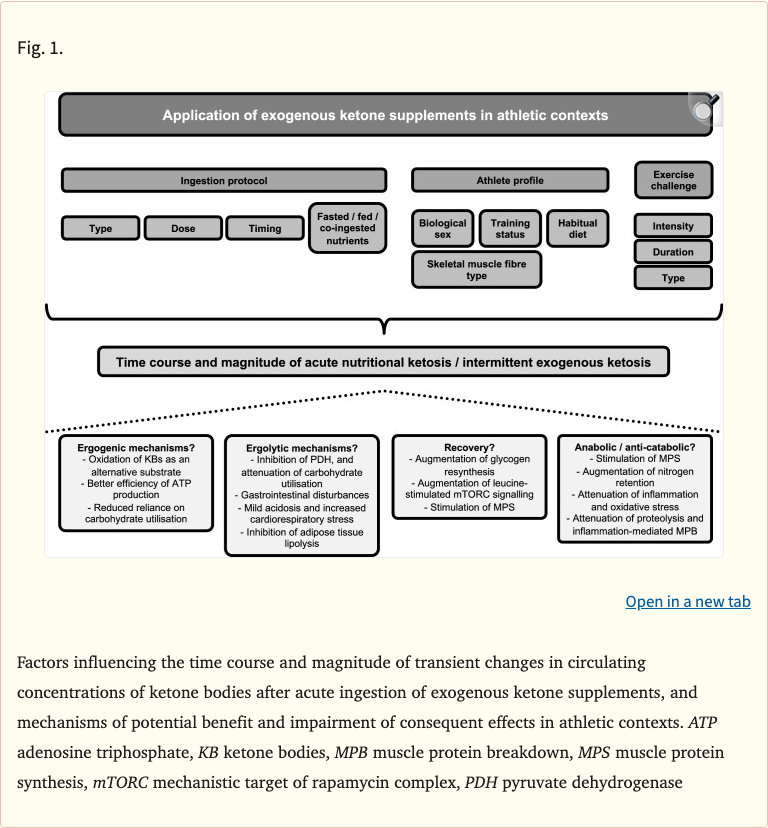 Figure 1
Limitations
- Narrative review rather than systematic review or meta-analysis, so evidence synthesis is qualitative
- Heterogeneity in supplement types, doses, and exercise protocols across reviewed studies makes direct comparisons difficult
- Many reviewed studies had small sample sizes
- Publication bias may overrepresent positive findings
- Long-term effects and safety data remain limited