Key Takeaway
Narrative review found no evidence that exogenous ketone supplementation improves exercise performance, citing insufficient understanding of ketone kinetics during exercise and potential interference with carbohydrate metabolism.
Summary
This narrative review examined the emerging interest in ketone body supplementation for athletic performance enhancement, particularly amid media speculation that professional cyclists were using ketone supplements. The authors reviewed the scientific literature on ketone body metabolism, availability, utilization during exercise, and the potential ergogenic effects of exogenous supplementation.
The review found that while skeletal muscle can use ketone bodies as fuel, uptake appears to saturate at relatively low concentrations (0.8-1.7 mmol/L), even though ketone supplements can raise blood levels to 3-6 mmol/L within 1-2 hours. Dietary strategies to increase endogenous ketone availability (ketogenic diets) require 4+ days of high-fat, low-carbohydrate eating, which may impair high-intensity exercise performance by reducing carbohydrate utilization.
The authors concluded that current understanding of ketone body kinetics during exercise is insufficient to warrant their use as an ergogenic aid in any practical sports setting. They noted that no data were available to support the claim that ingesting ketone bodies during exercise improves performance under conditions where evidence-based nutritional strategies are already applied appropriately. Key concerns included gastrointestinal tolerance, potential negative effects on carbohydrate availability during high-intensity efforts, and the lack of studies in trained athletes under realistic competitive conditions.
The review served as an important early critical assessment of the ketone supplement hype, tempering enthusiasm with a careful examination of the limited evidence base available at the time.
Methods
- Narrative review of existing literature on ketone body metabolism and exercise
- Examined studies across multiple conditions: fasting, ketogenic diets, exercise-induced ketosis, exogenous supplementation
- Reviewed both ketone salt and ketone ester supplement research
- Assessed evidence from animal models, untrained subjects, and trained athletes
Key Results
- Skeletal muscle ketone body uptake saturates between 0.8-1.7 mmol/L
- Ketone supplements can elevate blood concentrations to 3-6 mmol/L within 1-2 hours
- Ketone bodies may reduce glucose oxidation and hepatic glucose output during exercise
- Exercise enhances ketone body utilization capacity
- No data available showing ketone ingestion during exercise improves performance when evidence-based nutrition strategies are already used
- Ketogenic diets impair high-intensity exercise capacity due to reduced carbohydrate availability
Figures
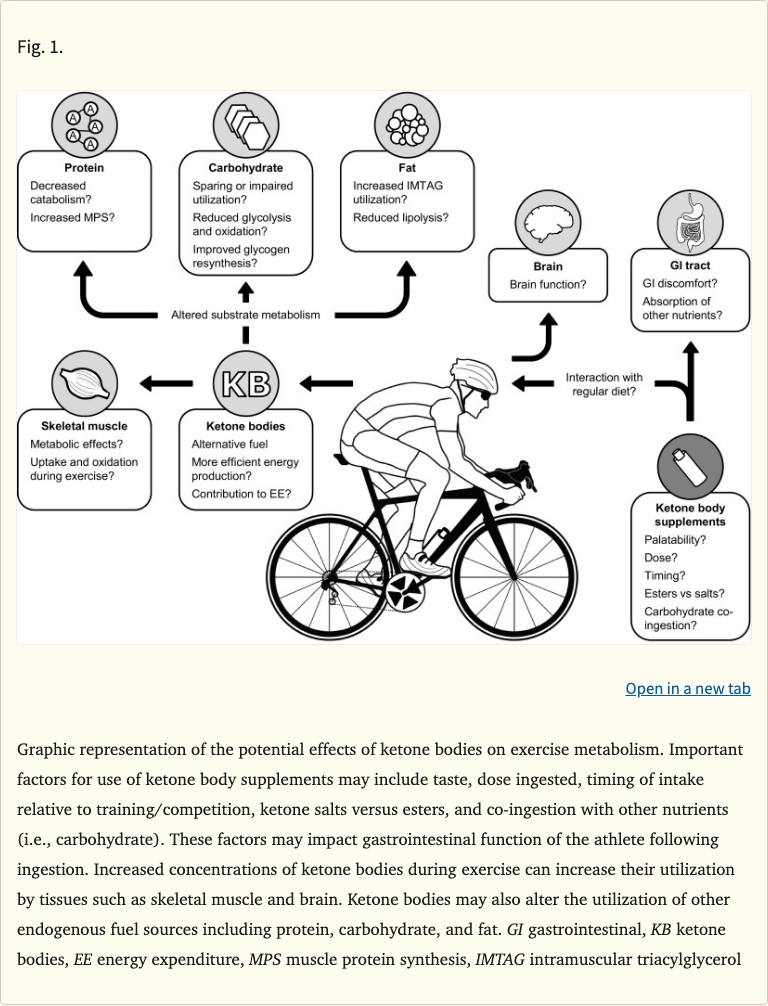 Figure 1
Limitations
- Narrative review (not systematic), so subject to selection bias
- Few human studies directly assessed ketone utilization during exercise in trained athletes at time of writing
- Most available evidence came from untrained subjects in fasted states with limited practical relevance
- Limited data on ketone ester supplementation during realistic competitive scenarios
- Gastrointestinal tolerance concerns were inadequately studied in the existing literature