
Key Takeaway
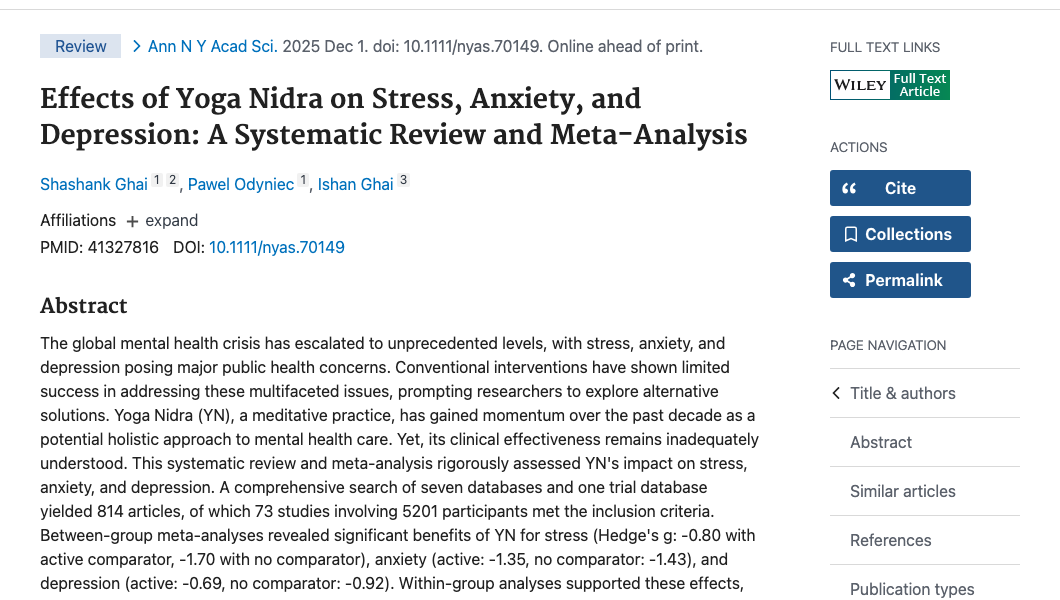
Meta-analysis of 73 studies (5,201 participants) found Yoga Nidra produced large reductions in stress (g = -0.80 to -1.70), anxiety (g = -1.35 to -1.43), and depression (g = -0.69 to -0.92) compared to active and no-intervention controls.
Summary
This systematic review and meta-analysis assessed the impact of Yoga Nidra on stress, anxiety, and depression. A comprehensive search across seven databases and one trial registry identified 814 articles, of which 73 studies involving 5,201 participants met inclusion criteria. The review represents the largest synthesis of Yoga Nidra research to date.
Between-group meta-analyses revealed significant benefits of Yoga Nidra across all three outcomes. For stress, effect sizes were large: Hedge's g = -0.80 against active comparators and -1.70 against no-intervention controls. Anxiety showed similarly robust effects (g = -1.35 and -1.43), and depression also improved significantly (g = -0.69 and -0.92). Within-group analyses reinforced these findings, supporting Yoga Nidra's therapeutic potential.
However, the authors caution that methodological quality across studies was generally low, and intervention delivery varied considerably. These factors likely inflate the observed effect sizes. Despite these limitations, the results suggest Yoga Nidra holds meaningful promise as a complementary approach for managing stress, anxiety, and depression symptoms.
Methods
Systematic review and meta-analysis following PRISMA guidelines. Seven databases and one trial registry were searched. Of 814 identified articles, 73 studies with 5,201 total participants met inclusion criteria. Both between-group (vs active and no-intervention comparators) and within-group analyses were conducted. Effect sizes were reported as Hedge's g.
Key Results
Stress: Hedge's g = -0.80 (vs active comparator), -1.70 (vs no comparator). Anxiety: Hedge's g = -1.35 (vs active), -1.43 (vs no comparator). Depression: Hedge's g = -0.69 (vs active), -0.92 (vs no comparator). All effects were statistically significant. Within-group analyses corroborated these between-group findings.
Limitations
Low overall methodological quality across included studies. High variability in Yoga Nidra intervention delivery (duration, frequency, instructor qualifications). Effect sizes are likely inflated due to these quality issues. Many studies lacked adequate blinding or randomization. Publication bias may further overestimate effects.