Key Takeaway
Comprehensive review found reasonable clinical trial evidence supporting red/NIR light therapy for skin rejuvenation, acne, wound healing, and hair loss, though commercial adoption has outpaced rigorous research.
Summary
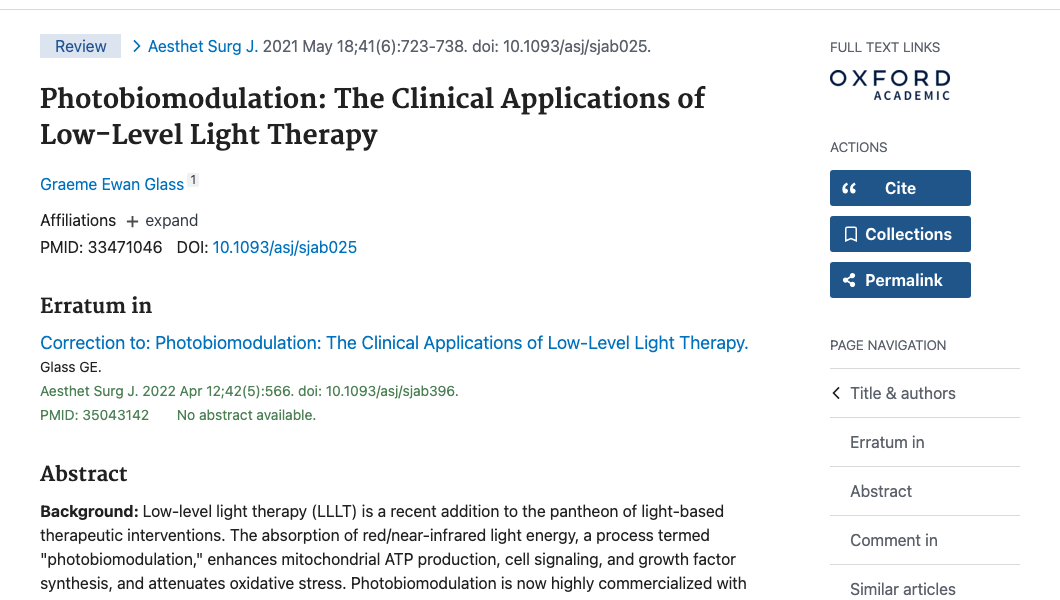
This review by Glass examined the clinical evidence for photobiomodulation (PBM) using low-level red and near-infrared light therapy across a range of medical and aesthetic applications. The paper synthesizes evidence for conditions including facial wrinkles, skin discoloration, acne, wound healing, body contouring, and androgenic alopecia.
The author explains the core mechanism: red and near-infrared light energy enhances mitochondrial ATP production, strengthens cellular function, and reduces oxidative damage. The review found a reasonable body of clinical trial evidence supporting the safety and efficacy of red/NIR light for skin rejuvenation, acne treatment, and hair loss management.
However, Glass highlights significant limitations in the existing literature, including small patient samples, industry funding bias, and unclear equivalence between LED and laser delivery systems. The review notes that commercial expansion of PBM devices has considerably outpaced rigorous, independent research, calling for well-designed clinical trials to establish definitive therapeutic value.
Methods
- Literature review of PBM clinical applications
- Analysis of evidence across multiple conditions
- Examination of regulatory oversight landscape
- Review of both LED and laser delivery systems
Key Results
- Reasonable clinical evidence for skin rejuvenation applications
- Evidence supporting PBM for acne treatment
- Positive findings for androgenic alopecia
- Wound healing benefits demonstrated
- Safety profile generally favorable across applications
- Core mechanism: enhanced mitochondrial ATP production via cytochrome c oxidase
Limitations
- Small patient samples in many clinical trials
- Industry funding bias in existing studies
- Unclear equivalence between LED and laser systems
- Commercial adoption has outpaced rigorous research
- Optimal treatment parameters not well established