
Key Takeaway
Tai Chi reduces fall risk by 20% and fall rate by 31% in older adults, with greater benefits at higher exercise frequencies and with Yang style practice.
Summary
This systematic review and meta-analysis evaluated the effectiveness of Tai Chi for preventing falls in older adults across 18 randomized controlled trials involving 3,824 participants. Databases searched included the Cochrane Library, MEDLINE, and EMBASE through February 2016, with study quality assessed using Cochrane Collaboration risk-of-bias tools.
The pooled analysis found that Tai Chi significantly reduced both the number of people who fell (RR 0.80, 95% CI 0.72 to 0.88) and the overall rate of falls (IRR 0.69, 95% CI 0.60 to 0.80) compared to control groups. Subgroup analyses revealed a clear dose-response relationship, with higher exercise frequency associated with greater fall prevention benefits. Yang style Tai Chi was more effective than Sun style for both outcomes.
These findings provide strong evidence supporting Tai Chi as an effective intervention for fall prevention in older adults, with practical implications for public health programs targeting this high-risk population.
Methods
- Systematic search of Cochrane Library, MEDLINE, and EMBASE through February 2016
- Included only randomized controlled trials of Tai Chi for fall prevention in older adults
- 18 trials with 3,824 participants identified
- Risk of bias assessed using Cochrane Collaboration tools
- Random effects meta-analysis for pooled estimates
- Subgroup analyses by exercise frequency and Tai Chi style
- Publication bias assessed via funnel plot
Key Results
- Number of fallers reduced: RR 0.80 (95% CI 0.72 to 0.88)
- Fall rate reduced: IRR 0.69 (95% CI 0.60 to 0.80)
- Dose-response for fallers: p=0.001 (higher frequency = greater benefit)
- Dose-response for fall rate: p=0.007
- Yang style more effective than Sun style (p=0.01 for fallers, p=0.001 for fall rate)
- Possible publication bias based on funnel plot asymmetry
Figures
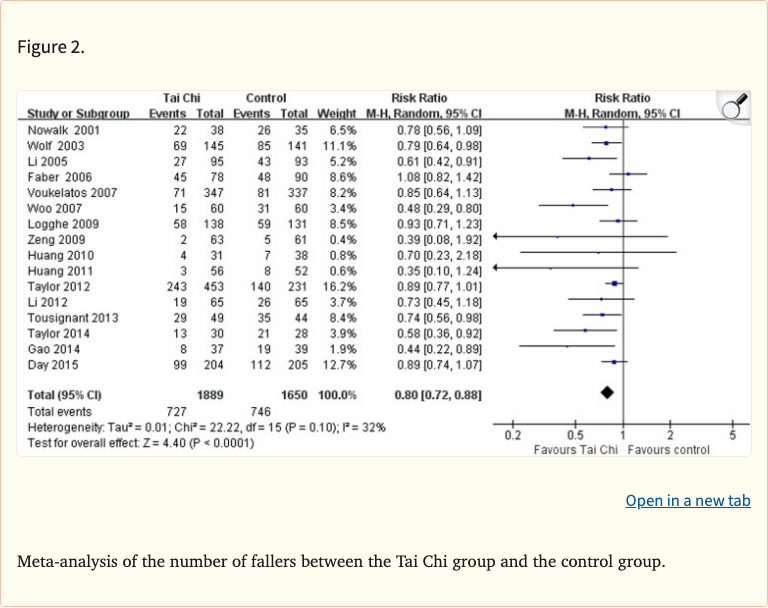 Figure 1
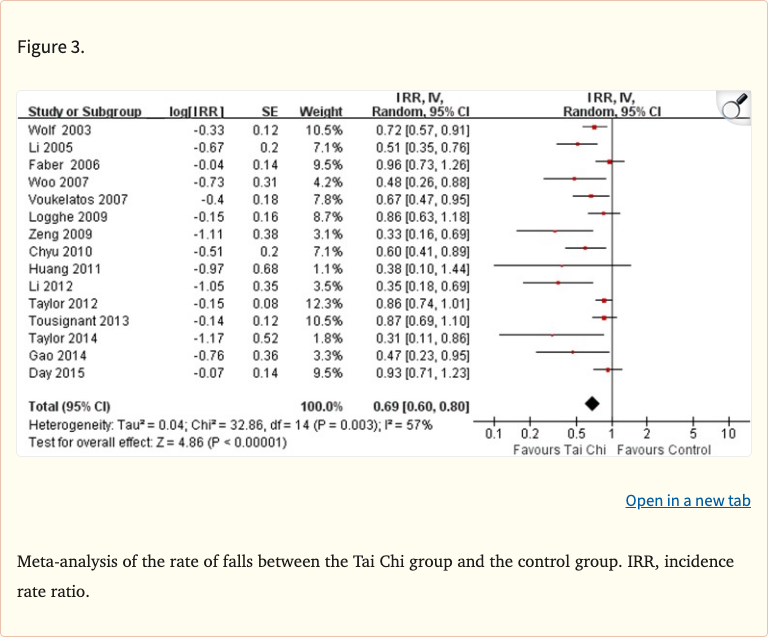 Figure 2
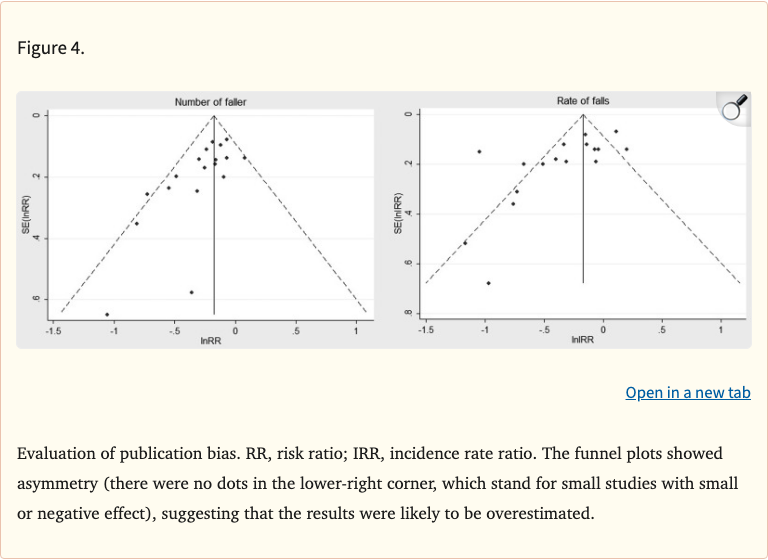 Figure 3
Limitations
- Possible publication bias detected in funnel plot
- Heterogeneity in Tai Chi protocols across trials (style, duration, frequency)
- Most trials conducted in community-dwelling older adults, limiting generalizability to frailer populations
- Search limited to February 2016, missing more recent trials
- Variable quality across included studies