
Key Takeaway
Hypertonic saline nasal irrigation improves symptoms over isotonic saline for sinonasal diseases, with larger effects in children and with high-volume delivery, though minor side effects are more common.
Summary
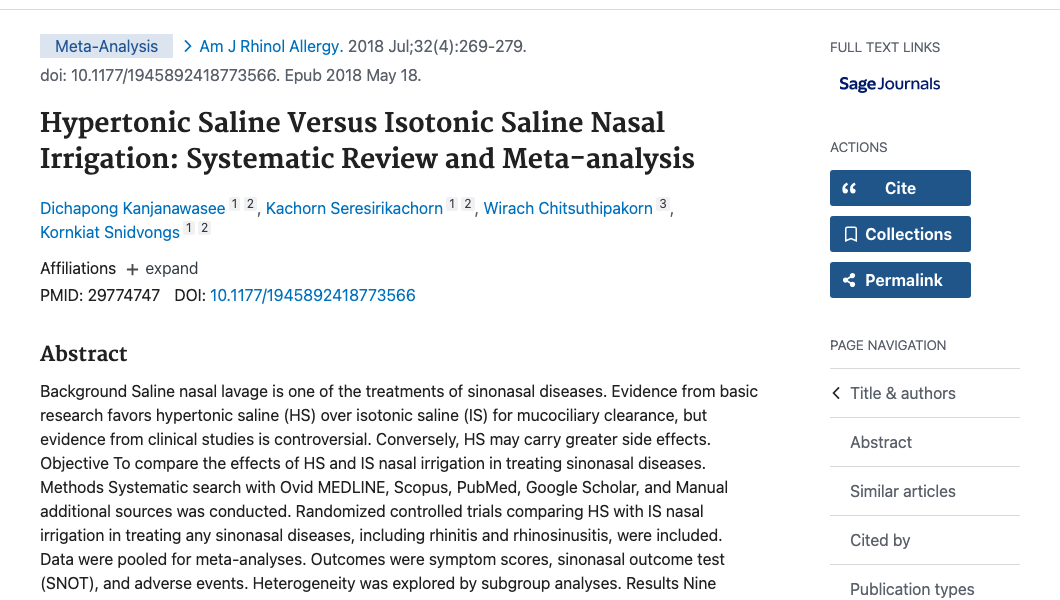
This systematic review and meta-analysis compared hypertonic saline (HS) to isotonic saline (IS) nasal irrigation for sinonasal diseases. Nine randomized controlled trials with 740 total patients were included.
The pooled analysis found HS significantly superior for symptom reduction (SMD=-0.58) compared to IS. Subgroup analyses revealed notably larger effects in pediatric patients (SMD=-1.22) versus adults (SMD=-0.26), suggesting children may benefit more from hypertonic formulations. High-volume irrigation was also more effective than low-volume methods, and concentrations below 5% hypertonicity showed better results than higher concentrations.
Disease-specific quality of life measured by the SNOT-20 questionnaire showed no meaningful difference between the two saline types. HS did produce more minor adverse effects such as nasal irritation and burning, though no major adverse events were reported in either group.
The findings support hypertonic saline as the preferred concentration for nasal irrigation in sinonasal diseases, particularly for pediatric patients, while acknowledging the tradeoff of slightly increased minor side effects.
Methods
- Systematic review and meta-analysis of randomized controlled trials
- 9 RCTs included, 740 total patients
- Compared hypertonic vs isotonic saline nasal irrigation
- Population: patients with sinonasal diseases (rhinosinusitis, rhinitis)
- Subgroup analyses by age, delivery volume, and saline concentration
- Primary outcome: symptom scores (standardized mean difference)
- Secondary outcomes: SNOT-20 quality of life, adverse effects
Key Results
- Hypertonic saline superior for symptom reduction (SMD=-0.58)
- Larger effect in children (SMD=-1.22) vs adults (SMD=-0.26)
- High-volume irrigation more effective than low-volume
- Concentrations below 5% hypertonicity more effective than higher
- No difference in SNOT-20 quality of life scores
- Hypertonic saline caused more minor adverse effects (burning, stinging)
- No major adverse effects in either group
Limitations
- Heterogeneity in study populations (rhinitis, sinusitis, mixed)
- Variable irrigation methods and concentrations across studies
- SNOT-20 showed no difference despite symptom improvement
- Most studies had relatively small sample sizes
- Optimal hypertonic concentration not definitively established
- Limited long-term follow-up data