Key Takeaway
Finnish men using sauna 4-7 times weekly had significantly lower CRP levels both at baseline and after 11 years of follow-up, suggesting reduced chronic inflammation as a key mechanism behind sauna's health benefits.
Summary
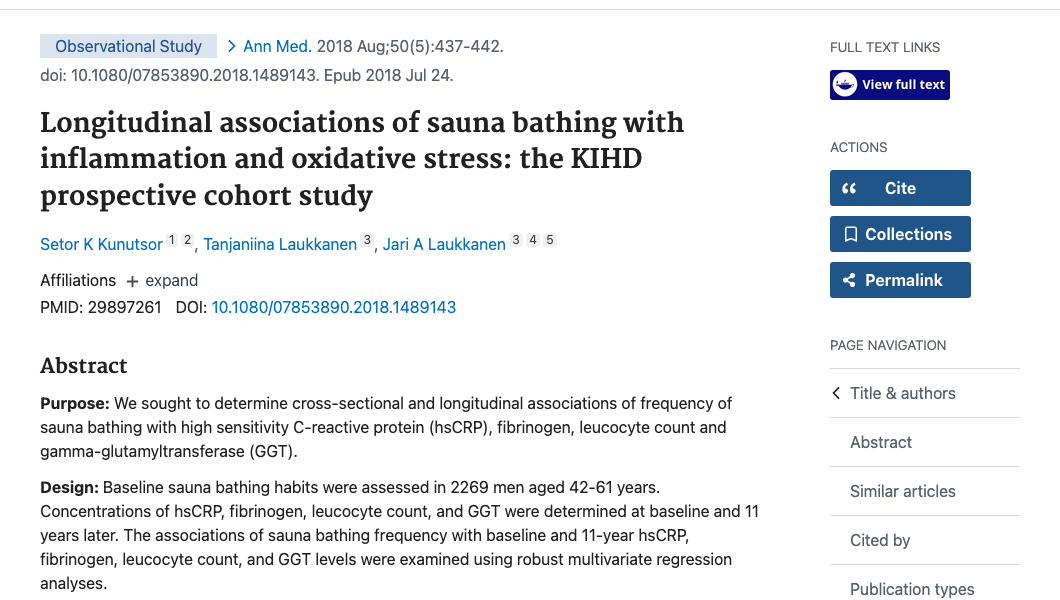
This prospective cohort study from the Kuopio Ischemic Heart Disease (KIHD) Study investigated whether the frequency of sauna bathing is associated with markers of inflammation and oxidative stress, both cross-sectionally and longitudinally over an 11-year follow-up period. The study included 2,269 Finnish men aged 42-61 years.
At baseline, men who used the sauna 4-7 times per week had significantly lower high-sensitivity C-reactive protein (hsCRP) levels compared to those using sauna once weekly, with an adjusted difference of -0.84 mg/L. Remarkably, this inverse association strengthened over time: at the 11-year follow-up measurement, frequent sauna users showed an even larger reduction in hsCRP of -1.66 mg/L compared to infrequent users.
The study also examined fibrinogen, white blood cell count, and gamma-glutamyltransferase (GGT) as additional inflammatory and oxidative stress markers. While frequent sauna use showed inverse associations with several inflammatory markers, no significant relationship was found with oxidative stress markers. The authors concluded that reduced systemic inflammation is likely one of the key biological pathways through which regular sauna bathing decreases the risk of acute and chronic disease.
Methods
- Prospective cohort from the KIHD Study in Eastern Finland
- 2,269 men aged 42-61 years at baseline
- Sauna frequency self-reported (1x, 2-3x, 4-7x per week)
- Inflammatory markers measured at baseline and 11-year follow-up: hsCRP, fibrinogen, leucocyte count
- Oxidative stress marker: gamma-glutamyltransferase (GGT)
- Multivariable-adjusted linear regression models
- Adjusted for age, BMI, smoking, alcohol, physical activity, diabetes, CVD history, medications
Key Results
- Baseline (cross-sectional) analysis:
- 4-7 sessions/week vs 1 session/week: hsCRP -0.84 mg/L (95% CI -1.55 to -0.14, p=0.019)
- Inverse associations also seen with fibrinogen and leucocyte count
- 11-year longitudinal analysis:
- 4-7 sessions/week vs 1 session/week: hsCRP -1.66 mg/L (95% CI -3.13 to -0.19, p=0.027)
- Stronger effect at follow-up suggests cumulative anti-inflammatory benefit
- No significant associations between sauna frequency and GGT (oxidative stress marker)
- Dose-response relationship: more frequent sauna use associated with progressively lower inflammation
Limitations
- Observational study (cannot establish causation)
- Only Finnish men included (limited generalizability to women and other populations)
- Sauna habits assessed at baseline only (may not reflect changes over follow-up)
- Inflammatory markers measured at only two time points (baseline and 11 years)
- Residual confounding possible despite multivariable adjustment
- Healthy user bias cannot be fully excluded
Related Interventions
Related Studies
More by Kunutsor
Discussed In