Key Takeaway
Blue-light-blocking glasses did not significantly improve objectively measured sleep outcomes (total sleep time, sleep efficiency, sleep onset latency, or wake after sleep onset) compared to clear lenses in randomized crossover trials using actigraphy.
Summary
This systematic review and meta-analysis specifically examined randomized controlled crossover trials that used actigraphy (objective wrist-worn sleep measurement) to assess whether blue-light-blocking glasses improve sleep outcomes. By focusing exclusively on crossover designs with objective measurement, the authors aimed to provide a more rigorous assessment than previous reviews that included subjective measures.
The meta-analysis pooled data from multiple RCTs comparing blue-light-blocking glasses to clear control lenses. The primary outcomes were total sleep time, sleep efficiency, sleep onset latency, and wake after sleep onset (WASO) as measured by actigraphy. The forest plot analyses revealed no statistically significant improvements in any of these objective sleep parameters when participants wore blue-blocking glasses compared to clear lenses.
These null findings are notable because they contrast with some earlier studies reporting subjective sleep improvements with blue-blocking glasses. The discrepancy suggests that perceived sleep benefits may not translate to objectively measurable changes in sleep architecture, or that the effect sizes are too small to detect with actigraphy in the sample sizes studied. The authors highlighted the need for larger trials and consideration of individual differences in light sensitivity.
Methods
Systematic search of PubMed, Scopus, Web of Science, and Cochrane Library for randomized controlled crossover trials comparing blue-light-blocking glasses to clear/placebo lenses. Only studies using actigraphy for objective sleep measurement were included. Meta-analysis was conducted using random-effects models for four outcomes: total sleep time (TST), sleep efficiency (SE), sleep onset latency (SOL), and wake after sleep onset (WASO). Risk of bias was assessed using Cochrane tools. Forest plots were generated for each outcome.
Key Results
- No significant difference in total sleep time between blue-blocking and clear lenses (pooled effect crossed null)
- No significant improvement in sleep efficiency with blue-blocking glasses
- Sleep onset latency was not significantly reduced by blue-blocking glasses
- Wake after sleep onset (WASO) showed no significant difference between conditions
- High heterogeneity was observed in some outcomes
- Subgroup analyses did not reveal consistent moderating factors
Figures
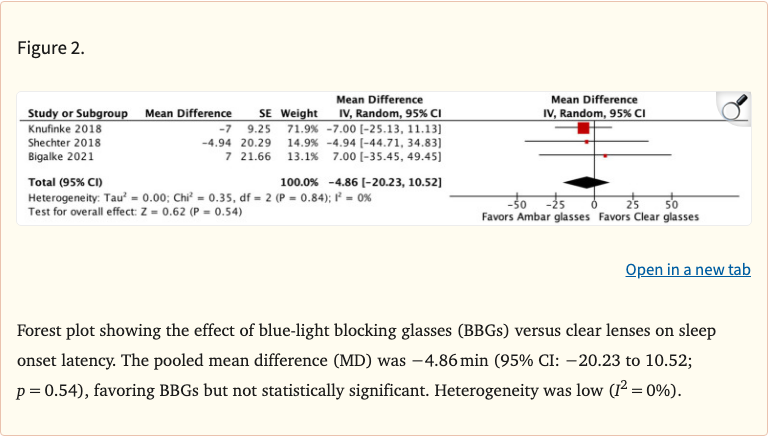 Figure 1
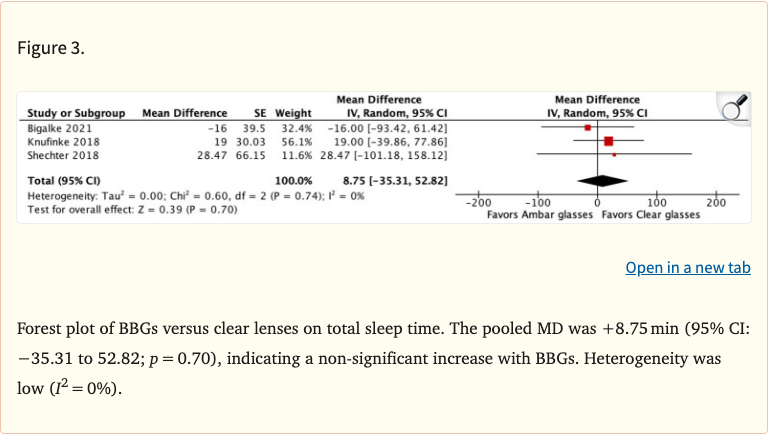 Figure 2
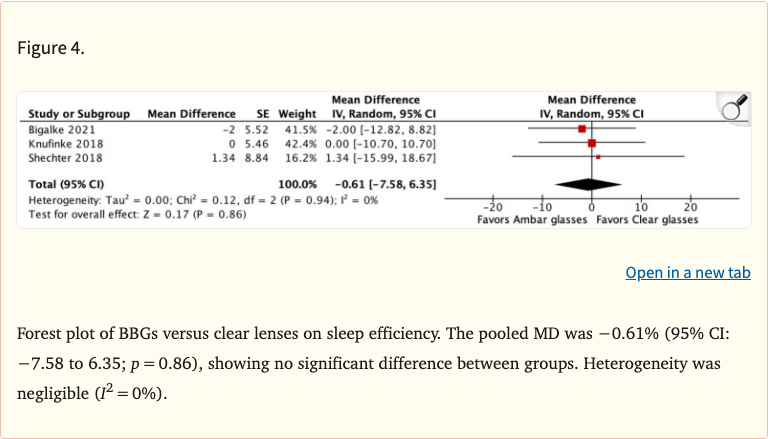 Figure 3
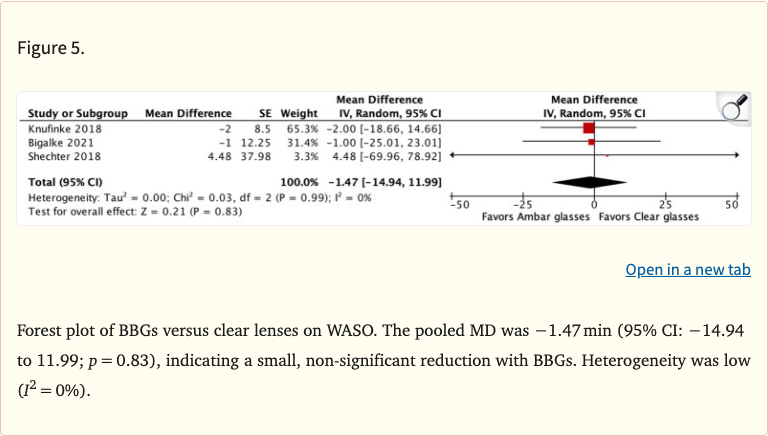 Figure 4
Limitations
- Limited number of eligible crossover RCTs with actigraphy data
- Actigraphy, while objective, is less precise than polysomnography for sleep staging
- Intervention duration varied across studies (single night to multiple weeks)
- Blue-blocking lens specifications (wavelength cutoff, transmittance) varied between studies
- Could not assess subjective sleep quality as this was restricted to actigraphy outcomes
- Publication bias cannot be fully ruled out given the small number of included studies
Related Interventions
Related Studies
Discussed In