
Key Takeaway
Cochrane review of 17 RCTs found blue-light filtering lenses probably have little or no effect on visual acuity or eye strain, with inconsistent and inconclusive evidence for sleep improvement.
Summary
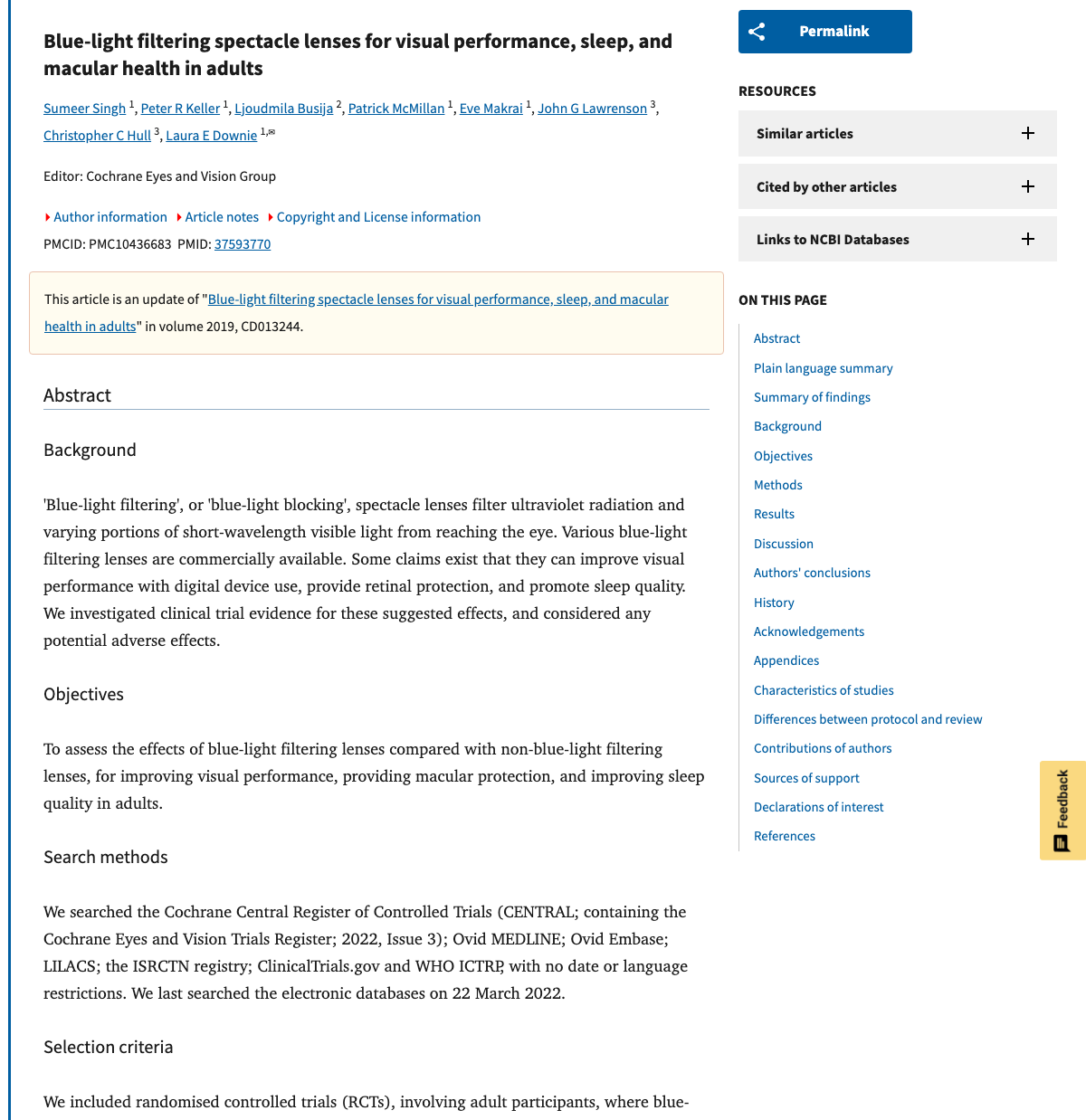
This Cochrane systematic review assessed the effects of blue-light filtering spectacle lenses compared to standard (non-blue-light filtering) lenses on visual performance, sleep quality, and macular health in adults. The Cochrane Database is considered the gold standard for systematic reviews, making this a particularly authoritative assessment of the evidence.
The review included 17 randomized controlled trials with sample sizes ranging from 5 to 156 participants and follow-up periods from less than one day to five weeks. The authors searched multiple databases through March 2022 and applied rigorous Cochrane methodology to assess certainty of evidence.
For visual performance, the review found "probably little or no effect" of blue-light filtering lenses on visual acuity compared to standard lenses. For eye strain, there "may be no difference in subjective visual fatigue scores" between blue-light filtering and standard lenses at short-term follow-up. For sleep quality, findings were inconsistent across six RCTs - three reported improvements and three found no difference - leading the authors to rate this evidence as indeterminate. No included studies evaluated macular health outcomes, so the review could not assess this claimed benefit.
The authors concluded that current evidence does not support the use of blue-light filtering lenses for reducing eye strain from computer use, and highlighted the need for larger, higher-quality trials to clarify potential effects on sleep and long-term eye health.
Methods
- Cochrane systematic review methodology (gold standard)
- Searched multiple databases through March 2022
- Included only randomized controlled trials comparing blue-light filtering lenses to standard lenses
- 17 RCTs identified, with 5-156 participants per study
- Follow-up periods ranged from less than 1 day to 5 weeks
- Assessed outcomes: visual acuity, eye strain, sleep quality, macular health
- Used GRADE framework to rate certainty of evidence
Key Results
- Visual acuity: Probably little or no effect of blue-light filtering lenses (moderate certainty)
- Eye strain: May be no difference in subjective visual fatigue at short-term follow-up (low certainty)
- Sleep quality: Inconsistent findings across 6 RCTs (3 positive, 3 null) - indeterminate
- Macular health: No studies evaluated this outcome - unable to determine effect
- Critical flicker-fusion frequency: No meaningful difference detected
Limitations
- Most included studies had small sample sizes
- Short follow-up periods (max 5 weeks) may miss long-term effects
- No studies assessed macular health outcomes
- Inconsistent sleep outcome measures across studies
- Studies did not consistently measure evening-specific blue-light blocking (many tested all-day wear)
- Cannot separate daytime computer use effects from evening circadian effects
- Industry funding in some included trials

