
Key Takeaway
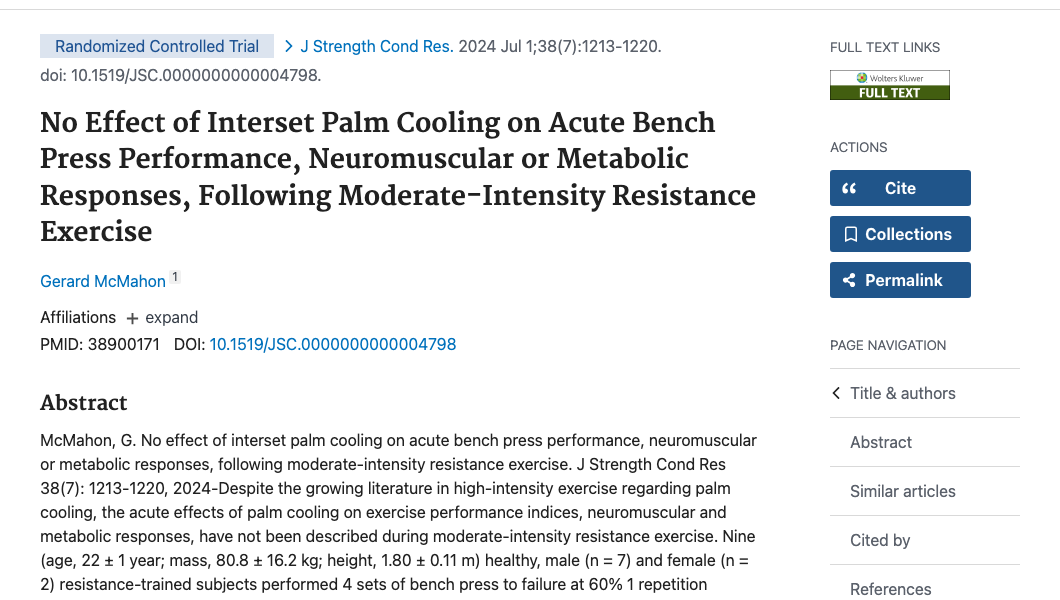
Interset palm cooling at 10°C during moderate-intensity bench press (60% 1RM) had no effect on volume load, repetitions, barbell velocity, muscle activation, blood lactate, or RPE in 9 resistance-trained subjects.
Summary
This study examined whether interset palm cooling could enhance performance during moderate-intensity resistance exercise. Nine healthy, resistance-trained subjects (7 male, 2 female, mean age 22 years) performed 4 sets of bench press to failure at 60% of their 1 repetition maximum with 3-minute passive recovery between sets.
In a randomized crossover design, subjects completed either a cooling condition (2 minutes of palm cooling at 10°C between sets) or a control condition (passive rest) separated by one week. While the cooling intervention successfully reduced palm temperature compared to control (p < 0.001), it failed to translate into any performance or physiological benefits.
No significant differences were found between conditions for volume load, repetitions, barbell velocity, muscle activation, blood lactate, or rate of perceived exertion (all p > 0.05). The authors conclude that palm cooling does not enhance acute moderate-intensity resistance exercise, suggesting its proposed ergogenic effects may be limited to high-intensity or heat-stress contexts.
Methods
Randomized crossover design with 9 resistance-trained subjects. Each subject performed 4 sets of bench press to failure at 60% 1RM with 3-minute rest periods. Cooling condition: 2 minutes of palm cooling at 10°C during rest periods. Control condition: passive rest. One week washout between conditions. Outcome measures included volume load, repetitions, barbell velocity, muscle activation (EMG), blood lactate, and RPE.
Key Results
Palm temperature was significantly lower in the cooling condition vs control (p < 0.001), confirming the cooling intervention worked. However, no significant differences (all p > 0.05) were found between conditions for any performance variable (volume load, repetitions, barbell velocity), neuromuscular response (muscle activation), or metabolic response (blood lactate, RPE).
Limitations
Very small sample size (n=9) limits statistical power to detect small effects. Only moderate-intensity exercise was tested (60% 1RM), which may not generate sufficient heat stress for cooling to be beneficial. Single exercise (bench press) limits generalizability. No core or skin temperature measurements beyond the palm were reported. Only male-dominated sample (7 male, 2 female).