
Key Takeaway
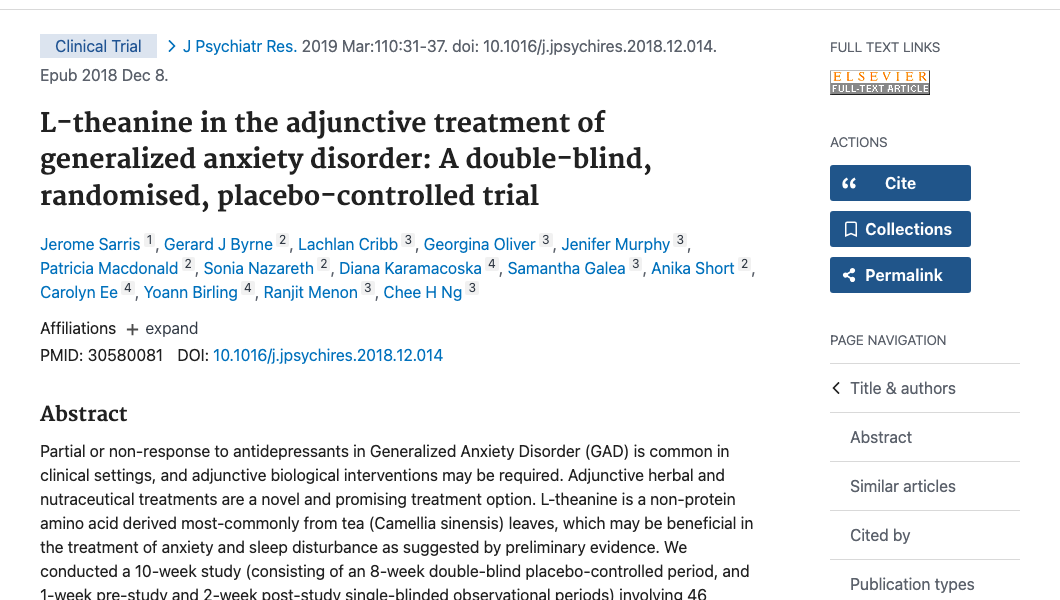
An 8-week RCT in 46 GAD patients found that adjunctive L-theanine (450-900mg/day) significantly improved sleep satisfaction and reduced insomnia symptoms compared to placebo, though primary anxiety outcomes did not reach statistical significance.
Summary
This double-blind, randomised, placebo-controlled trial investigated L-theanine as an adjunctive treatment for generalized anxiety disorder (GAD). Conducted across multiple sites in Australia, the study enrolled 46 participants with DSM-5-diagnosed GAD who were already on stable antidepressant or anxiolytic therapy. Participants were randomized to receive either L-theanine (450mg/day for the first 2 weeks, then 900mg/day for weeks 3-8) or placebo alongside their existing treatment.
While the primary outcome (Hamilton Anxiety Rating Scale) did not show a statistically significant difference between groups at week 8, the L-theanine group demonstrated notable improvements in sleep-related measures. Specifically, L-theanine significantly improved sleep satisfaction on the ISI (Insomnia Severity Index) item score compared to placebo. The treatment was well-tolerated with no serious adverse events attributed to the supplement.
This trial is significant as one of the first rigorous RCTs examining L-theanine specifically in a clinically diagnosed GAD population. The positive sleep findings align with L-theanine's known mechanism of promoting alpha brain wave activity and GABAergic modulation. The lack of significance on the primary anxiety measure may reflect the add-on design (participants were already on medication) and the relatively small sample size limiting statistical power.
Methods
Double-blind, randomised, placebo-controlled trial at multiple Australian sites. 46 participants with DSM-5 GAD on stable medication were randomized to L-theanine (450mg/day weeks 1-2, then 900mg/day weeks 3-8) or placebo. Primary outcome: Hamilton Anxiety Rating Scale (HAM-A) at 8 weeks. Secondary outcomes included Insomnia Severity Index (ISI), sleep quality measures, and Clinical Global Impression scales.
Key Results
- Primary outcome (HAM-A): No significant difference between L-theanine and placebo groups at week 8
- Sleep satisfaction (ISI item): Significantly improved in L-theanine vs placebo (p < 0.05)
- Insomnia symptoms showed greater improvement with L-theanine
- No serious adverse events attributed to L-theanine
- L-theanine was well-tolerated at doses up to 900mg/day for 8 weeks
- Treatment compliance was high in both groups
Limitations
- Small sample size (n=46) limiting statistical power
- Adjunctive design makes it difficult to isolate L-theanine's independent effects
- Participants on varied background medications (antidepressants, benzodiazepines)
- Primary anxiety outcome did not reach significance
- 8-week duration may be insufficient for full anxiolytic effects
- Single-country sample (Australia) limits generalizability