
Key Takeaway
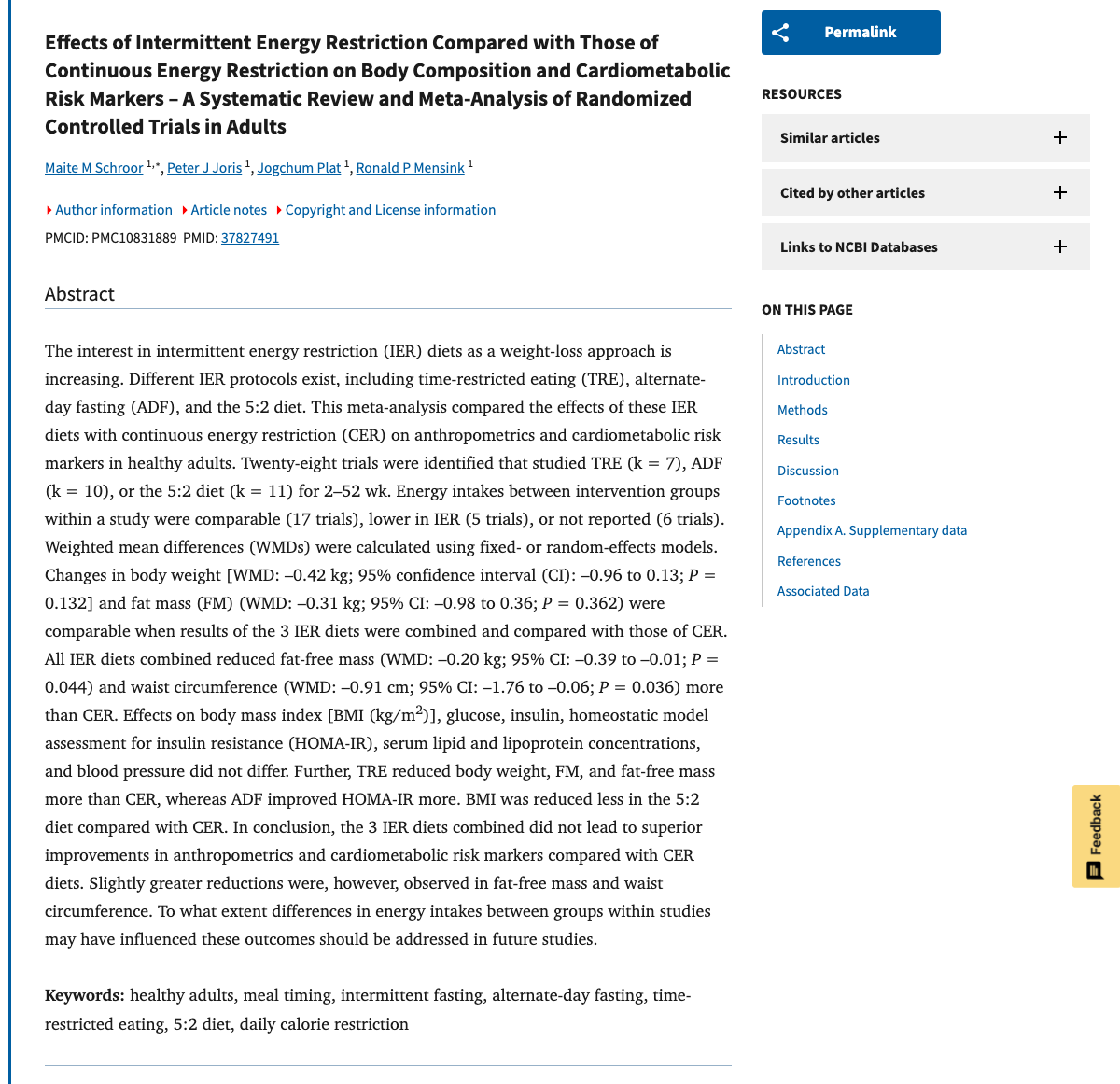
Intermittent energy restriction produces similar weight loss and cardiometabolic improvements as continuous calorie restriction, with no significant differences in body composition, lipids, glucose, or blood pressure outcomes.
Summary
This systematic review and meta-analysis directly compared intermittent energy restriction (IER) protocols with continuous energy restriction (CER) across randomized controlled trials in adults. IER protocols included alternate-day fasting, the 5:2 diet, and time-restricted eating, while CER represented traditional daily calorie-restricted diets. The analysis aimed to determine whether the intermittent approach offers any advantages beyond traditional dieting.
The meta-analysis pooled data from RCTs that included both an IER and CER arm, allowing head-to-head comparison. Outcomes included changes in body weight, fat mass, lean mass, waist circumference, blood lipids, fasting glucose, insulin, blood pressure, and inflammatory markers. The analysis found no significant differences between IER and CER for virtually all measured outcomes.
These findings suggest that intermittent energy restriction is a viable alternative to continuous calorie restriction but does not produce superior results for weight loss or cardiometabolic health. The practical implication is that individuals can choose whichever approach they find more sustainable, as metabolic outcomes are comparable. The authors noted that adherence and personal preference should guide dietary strategy rather than assumptions about metabolic advantages.
Methods
Systematic review and meta-analysis of randomized controlled trials comparing intermittent energy restriction (IER) directly with continuous energy restriction (CER) in adults. Searched PubMed, Embase, and Cochrane databases. Included RCTs with intervention periods of at least 4 weeks. Used random-effects models to pool mean differences. Risk of bias assessed using Cochrane RoB-2 tool. Subgroup analyses performed by IER protocol type (alternate-day fasting, 5:2, time-restricted eating).
Key Results
- No significant differences between IER and CER for body weight change
- Fat mass and lean mass reductions were comparable between approaches
- Waist circumference reductions similar in both groups
- No significant differences in fasting glucose, insulin, or HOMA-IR
- Lipid profile changes (total cholesterol, LDL, HDL, triglycerides) were equivalent
- Systolic and diastolic blood pressure changes did not differ significantly
- Subgroup analyses by IER protocol type showed consistent null differences
Limitations
- Most included trials were short-term (4-24 weeks), limiting long-term conclusions
- Sample sizes in individual RCTs were generally small
- Heterogeneity in IER protocols makes it difficult to assess specific approaches
- Adherence measurement varied across studies and was not always well-reported
- Limited data on psychological outcomes, eating behavior, or quality of life
- Publication bias cannot be fully excluded
