
Key Takeaway
First RCT of Alexander technique in Parkinson's showed improvements in depression, daily activities, and self-reported disability.
Summary
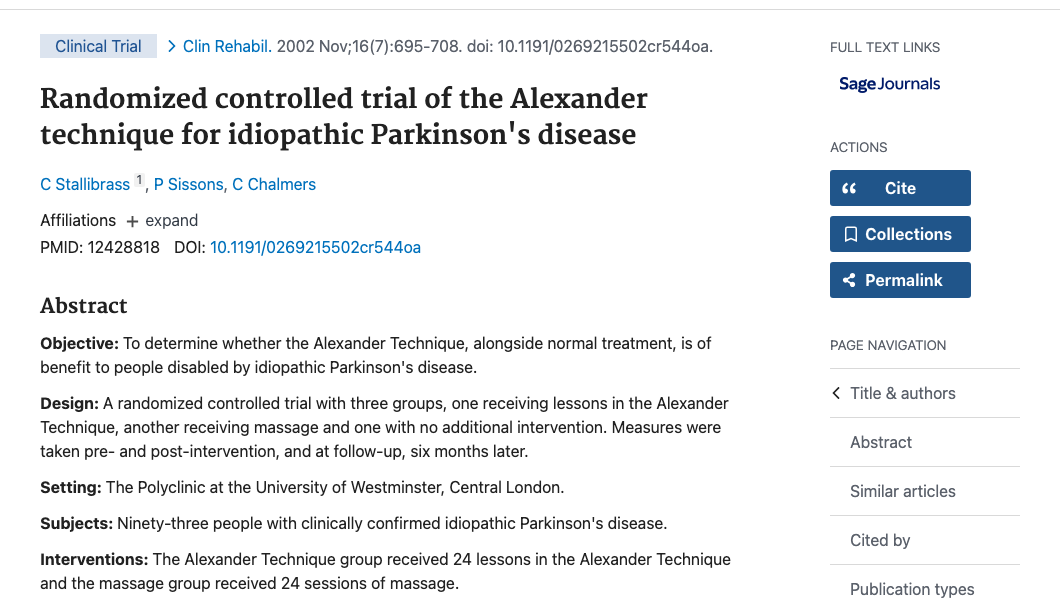
This pioneering randomized controlled trial evaluated the Alexander technique for people with Parkinson's disease, a condition characterized by movement difficulties, rigidity, and postural problems.
Participants receiving 24 Alexander lessons showed significant improvements in depression scores and ability to perform daily activities compared to controls. Self-assessed disability also improved, though objective measures of motor function showed smaller changes.
The study suggests Alexander technique may address quality of life aspects of Parkinson's beyond what standard medical treatment achieves, particularly psychological well-being and functional independence.
Methods
- 93 participants with idiopathic Parkinson's
- Randomized to 24 AT lessons or no additional treatment
- 6-month intervention period
- Outcomes: UPDRS, BDI (depression), ADL scales
Key Results
- Significant reduction in depression (BDI scores)
- Improved self-reported daily activities
- Better self-assessed disability
- No significant change in UPDRS motor scores
- Benefits maintained at follow-up
Limitations
- Cannot blind participants
- Attention effects from lessons possible
- Subjective outcomes showed more change than objective
- Single-center study