
Key Takeaway
First meta-analysis of objective cognitive outcomes from mindfulness-based program RCTs (56 studies, n=2,931) found a small effect favoring mindfulness (g=0.15), with stronger effects for executive function and working memory.
Summary
This systematic review and meta-analysis in Neuropsychology Review was the first to focus specifically on objective (performance-based) cognitive outcomes from randomized controlled trials of mindfulness-based programs (MBPs). By restricting to objective measures rather than self-reported cognitive functioning, the authors provided a more rigorous assessment of whether mindfulness actually improves cognitive performance.
The review included 56 RCTs with a total of 2,931 participants, comparing standardized mindfulness-based programs (such as MBSR, MBCT, and similar structured interventions) to various control conditions. Cognitive outcomes were assessed using validated neuropsychological tests across multiple domains.
The overall meta-analytic effect was small but statistically significant (Hedges' g=0.15) in favor of mindfulness-based programs. When broken down by cognitive domain, the strongest effects were observed for executive function and working memory, which aligns with the theoretical mechanisms of mindfulness practice — sustained attention, inhibitory control, and cognitive flexibility are core components of both meditation and executive function.
This study provides important foundational evidence that mindfulness training produces measurable cognitive improvements on objective tests, not just subjective reports. The domain-specific pattern of results supports the hypothesis that mindfulness enhances top-down attentional control processes.
Methods
- Systematic review and meta-analysis of 56 RCTs
- Total sample size: n=2,931 participants
- Included only studies using objective (performance-based) cognitive measures
- Assessed mindfulness-based programs (MBSR, MBCT, and similar) vs. control conditions
- Analyzed cognitive outcomes by domain (executive function, working memory, attention, etc.)
- Used Hedges' g for standardized effect sizes
- Conducted risk of bias assessment using Cochrane tools
Key Results
- Small overall effect favoring mindfulness: Hedges' g=0.15 (statistically significant)
- Strongest effects observed for executive function domain
- Working memory also showed meaningful improvements
- Effects were consistent across different MBP types
- Results held when controlling for study quality
Figures
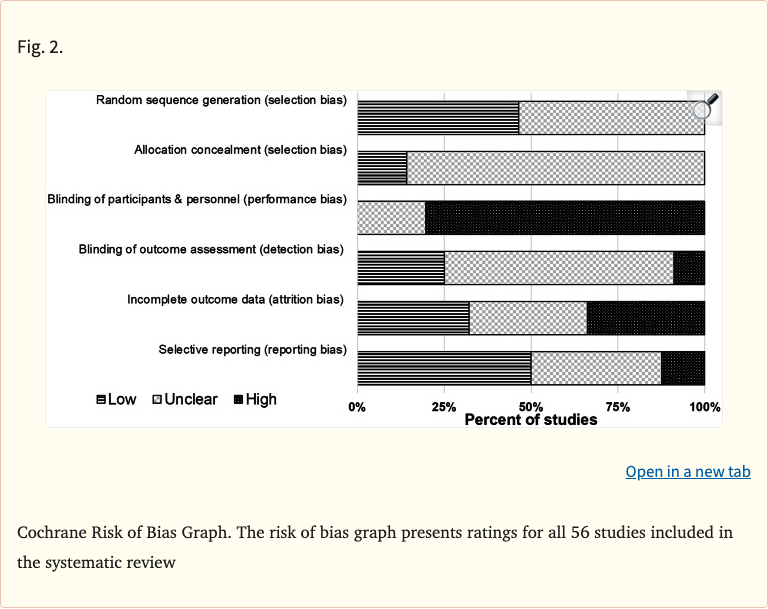 Figure 1
Limitations
- Small overall effect size (g=0.15) may have limited practical significance
- Heterogeneity in mindfulness program formats and durations
- Many included studies had small sample sizes
- Variable quality of control conditions across studies
- Some cognitive domains had too few studies for robust subgroup analyses
- Publication bias cannot be fully ruled out