
Key Takeaway
IPD meta-analysis confirmed mindfulness-based programs reduce psychological distress at 1-6 months, with strongest effects for those with higher baseline distress.
Summary
This individual participant data (IPD) systematic review and meta-analysis represents the most rigorous analysis of mindfulness-based programs (MBPs) for mental health promotion in non-clinical populations. By obtaining raw participant-level data from randomized controlled trials, the authors could examine treatment effect modifiers that aggregate-level meta-analyses cannot detect.
The review included data from multiple RCTs of standardized MBPs (such as MBSR and MBCT adapted for non-clinical use) delivered to adults without clinical mental health diagnoses. The primary outcome was psychological distress measured at 1-6 months post-intervention.
Results confirmed that MBPs significantly reduce psychological distress compared to no-intervention controls, with the strongest benefits observed in participants who entered the programs with higher baseline distress levels. This finding has important implications for targeting mindfulness interventions to those most likely to benefit.
Published in Nature Mental Health, this IPD meta-analysis provides high-quality evidence supporting mindfulness-based programs as effective mental health promotion tools, particularly for individuals experiencing elevated but sub-clinical psychological distress.
Methods
- Individual participant data (IPD) systematic review and meta-analysis
- Included RCTs of adult mindfulness-based programs in non-clinical settings
- Primary outcome: psychological distress at 1-6 months
- Used IPD to examine treatment effect modifiers at the participant level
- Compared MBPs to no-intervention control conditions
Key Results
- MBPs significantly reduced psychological distress vs. no-intervention controls
- Effects were most pronounced at 1-6 month follow-up
- Participants with higher baseline distress showed the strongest treatment effects
- Effect modification analysis confirmed baseline distress as a key moderator
Figures
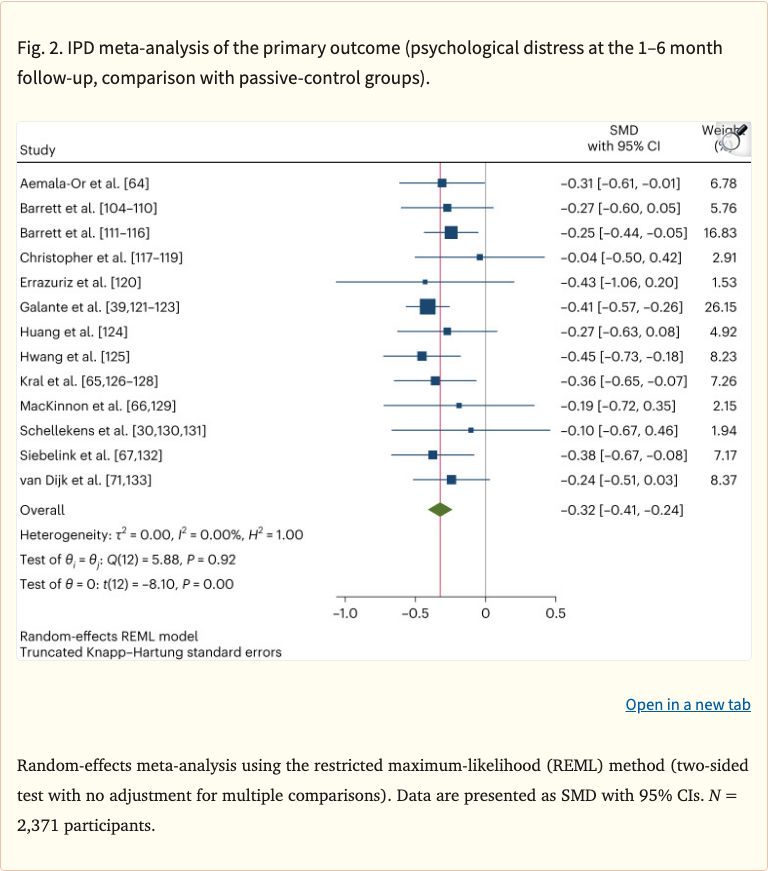 Figure 1
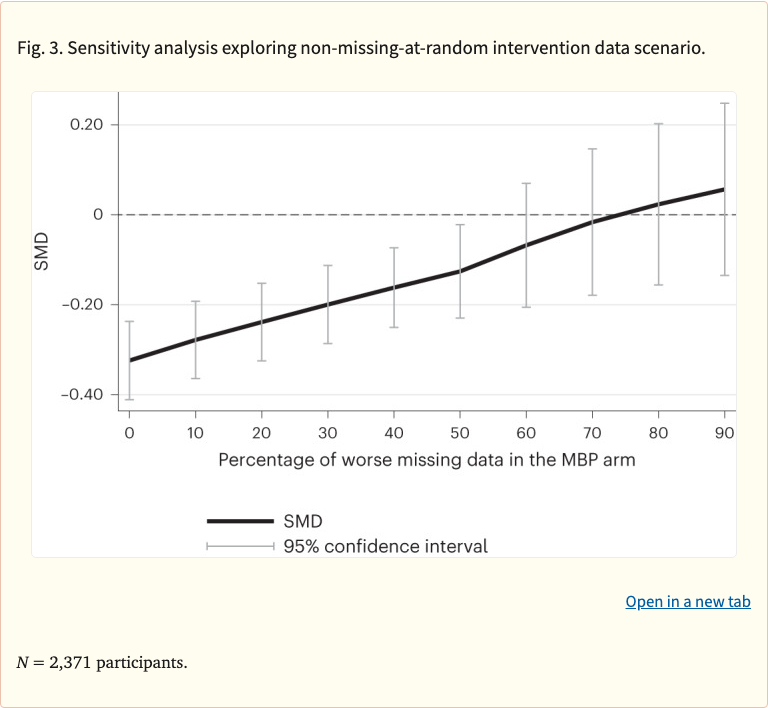 Figure 2
Limitations
- Focused on non-clinical populations, limiting generalizability to clinical groups
- Comparisons were primarily against no-intervention controls rather than active comparators
- Not all eligible trials contributed IPD, which may introduce availability bias
- Heterogeneity in MBP formats and delivery across included trials