
Key Takeaway
Resisted sled training significantly improves sprint acceleration (ES 0.61, p=0.0001) with greatest benefits from programs exceeding 160m per session over 6+ weeks
Summary
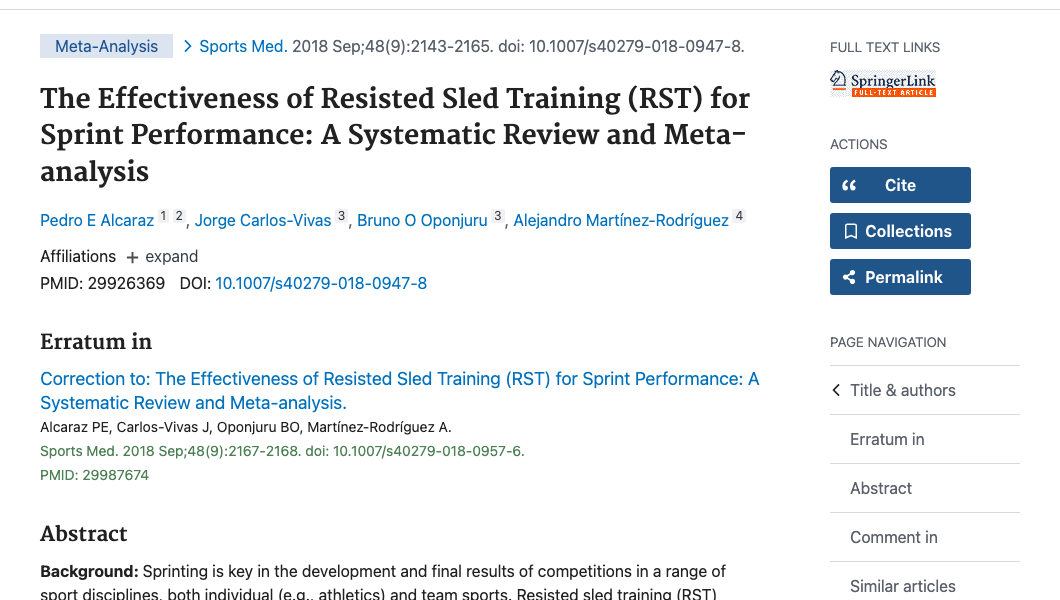
This systematic review and meta-analysis examined 13 studies with 32 resisted sled training (RST) groups and 15 control groups to determine the effectiveness of sled training for sprint performance. The authors searched PubMed, SPORTDiscus, and Web of Science for peer-reviewed experimental studies where participants towed or pulled a sled while running at maximum intensity.
The meta-analysis found significant improvements in the acceleration phase (effect size 0.61, p=0.0001) between baseline and post-training. Full sprint times also showed significant but smaller improvements. However, improvements in the maximum-velocity phase were non-significant, confirming that sled training primarily targets the early acceleration portion of a sprint.
When compared to control groups performing unresisted training, the differences were not statistically significant, suggesting that sled training is effective but not definitively superior to conventional sprint training. The authors recommended specific protocols for best results: total volume exceeding 160 meters per session (approximately 2,680m across the program), 2-3 sessions per week, and a minimum duration of 6 weeks. Training on rigid surfaces enhanced effectiveness.
Methods
- Systematic search of PubMed, SPORTDiscus, and Web of Science through January 2018
- Included peer-reviewed experimental studies with recreationally active or trained participants
- 13 studies with 32 RST groups and 15 control groups analyzed
- Effect sizes calculated for acceleration, full sprint, and maximum-velocity phases
- Subgroup analyses by population type, surface, and training volume
Key Results
- Acceleration phase: significant improvement (ES 0.61, p=0.0001)
- Full sprint: significant but smaller improvements
- Maximum-velocity phase: non-significant improvements
- No significant differences vs unresisted training control groups
- Greatest benefits in recreationally active/trained men in team sports
- Rigid surfaces enhanced training effectiveness
- Recommended volume: >160m per session, 2-3x/week, minimum 6 weeks
Limitations
- Not demonstrably superior to unresisted sprint training in direct comparisons
- Most subjects were male team sport athletes limiting generalizability
- Heterogeneity in loading protocols across studies
- Limited data on long-term retention of sprint improvements
- Few studies examined maximum-velocity phase specifically