
Key Takeaway
Resisted sled pulling specifically improves early acceleration via increased stride rate, while unresisted sprinting improves maximum velocity via increased stride length - each sprint phase demands its own training approach
Summary
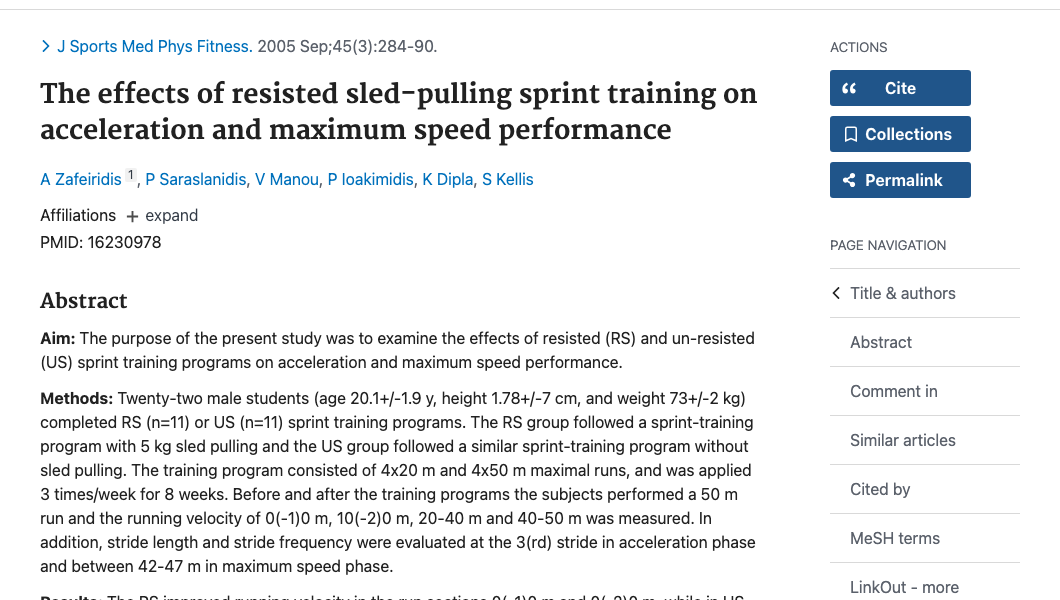
This randomized prospective study examined 22 male university students to compare the effects of resisted sled-pulling versus unresisted sprint training on different phases of sprint performance. Participants were divided into a resisted sprint group (n=11) using 5kg sled pulling and an unresisted sprint group (n=11). Both groups performed identical protocols of 4x20m and 4x50m maximal runs, three times per week for 8 weeks.
The key finding was a clear phase-specific training effect. Resisted sled-pulling significantly improved early acceleration (running velocity at 0-10m and 0-20m), while unresisted sprint training enhanced maximum speed performance (velocity at 20-40m and 40-50m). The mechanisms differed as well: stride rate increased only with resisted training in the acceleration phase (+7.1%), while stride length increased only with unresisted training at maximum speed (+5.5%).
This study provides foundational evidence that sprint training is phase-specific. Coaches seeking to improve acceleration should incorporate sled pulling, while those targeting maximum velocity should emphasize unresisted sprints. An integrated program using both methods may be optimal for developing all phases of sprint performance.
Methods
- 22 male university students (mean age 20.1 +/- 1.9 years)
- Randomized to resisted sprint (n=11, 5kg sled) or unresisted sprint (n=11)
- Protocol: 4x20m and 4x50m maximal runs, 3x/week for 8 weeks
- Performance measured: 50m run velocity at 0-10m, 0-20m, 20-40m, and 40-50m segments
- Stride length and stride frequency assessed during acceleration and maximum speed phases
Key Results
- Resisted training improved acceleration-phase velocity (0-10m and 0-20m segments)
- Unresisted training improved maximum-speed velocity (20-40m and 40-50m segments)
- Stride rate increased +7.1% only with resisted training in acceleration phase
- Stride length increased +5.5% only with unresisted training at maximum speed
- Phase-specific adaptations: each training method improved its corresponding sprint phase
- No crossover effect between training types and sprint phases
Limitations
- Small sample size (n=11 per group)
- Only male university students studied (non-elite)
- Single sled load used (5kg) which is relatively light
- No combined training group to test integrated programming
- 8-week duration may not capture longer-term adaptations
- No sport-specific performance measures included