
Key Takeaway
Resisted sled pushing at any load was superior to unresisted sprinting for improving acceleration in high school athletes, with heavy loads (75% velocity decrement) producing the greatest short-distance gains
Summary
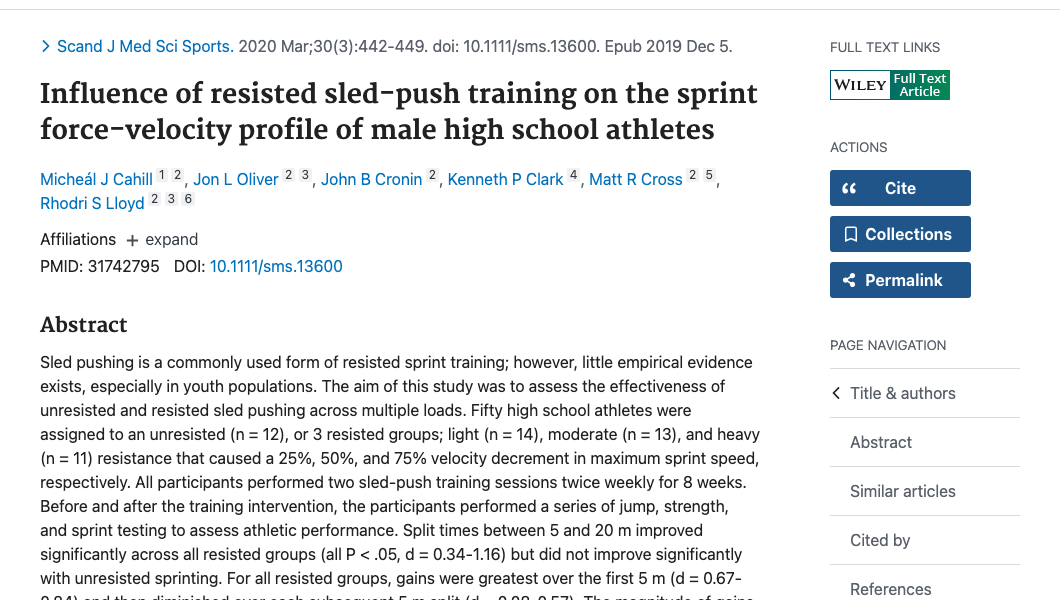
This randomized controlled trial examined 50 male high school athletes to determine the effects of different sled-push loading intensities on sprint performance and the force-velocity profile. Participants were assigned to four groups: unresisted sprinting, or resisted sled pushing at light (25%), moderate (50%), or heavy (75%) velocity decrements. All groups trained twice weekly for 8 weeks.
The results clearly favored resisted training. Split times improved significantly across all three resisted groups (p<0.05) but not in the unresisted training group. The greatest gains occurred in the first 5 meters of sprinting, with effect sizes ranging from 0.67 to 0.84. Heavy loads produced the largest increases in force and power output.
This study is notable because it is one of the first to examine sled pushing (rather than pulling) and to use a youth population. The finding that any resisted load outperformed unresisted training is particularly strong, and the dose-response relationship favoring heavier loads for short-distance acceleration has practical implications for coaches working with developing athletes.
Methods
- 50 male high school athletes randomized to four groups
- Groups: unresisted, light (25% velocity decrement), moderate (50%), heavy (75%)
- Two sled-push sessions per week for 8 weeks
- Pre and post testing: jumping, strength, and sprint assessments
- Force-velocity profiling to assess mechanical changes
Key Results
- All resisted groups improved split times significantly (p<0.05); unresisted group did not
- Greatest gains in first 5 meters (ES 0.67-0.84)
- Heavy loads produced the largest increases in sprint performance over short distances
- All groups showed increased force and power over time
- Heavy loads elicited the greatest gains in force-velocity profile
- Dose-response relationship: heavier loads produced better short-distance acceleration
Limitations
- Only male high school athletes studied
- Relatively small sample per group (approximately 12-13 per group)
- Only examined sled pushing, not pulling
- 8-week intervention may not capture long-term adaptations
- No follow-up to assess retention of training effects
- Velocity decrement approach may not translate directly to absolute load prescriptions