
Key Takeaway
Nasal breathing activates more brain regions during cognitive tasks (15 vs 10 areas), enhances default mode network connectivity, and produces more efficient diaphragmatic breathing compared to oral breathing.
Summary
This systematic review analyzed 11 studies involving 313 participants to compare the effects of nasal versus oral breathing on brain function and respiratory muscle activation. The review searched PubMed and Scopus databases from January 2000 through May 2024, applying PRISMA guidelines.
On the brain function side, nasal breathing activated 15 brain regions during working memory tasks compared to only 10 with oral breathing. Nasal breathing enhanced default mode network activity, increased gamma-range EEG frequencies, and showed greater functional connectivity in the left cerebellum and bilateral inferior parietal gyri. Slow nasal breathing produced elevated delta and theta rhythms in prefrontal and central posterior areas, while oral breathing effects were limited to posterior regions. The review suggests nasal airflow provides a direct entry point to limbic brain areas for modulating cognitive function.
For respiratory muscles, oral breathing was associated with reduced diaphragm activation, increased compensatory upper trapezius recruitment, and forward head posture that further compromises diaphragmatic effectiveness. Nasal breathers showed more efficient respiratory muscle patterns with appropriate diaphragmatic dominance.
Methods
- Systematic review following PRISMA guidelines
- Searched PubMed and Scopus (January 2000 to May 2024)
- Search terms: nasal/oral breathing combined with EMG and EEG
- 126 articles initially retrieved, 11 included in final review
- 91% of included studies were experimental designs
- Total of 313 participants (63% female, 15% children)
- 64% of studies focused on brain function, 36% on respiratory muscles
Key Results
- Nasal breathing activated 15 brain regions during working memory vs 10 for oral
- Enhanced default mode network activity with nasal breathing
- Higher delta/theta EEG power after slow nasal breathing
- Higher beta/gamma waves during cognitive tasks with nasal breathing
- Increased upper trapezius EMG activity during oral breathing
- Reduced diaphragm activation amplitude with oral breathing
- Higher SpO2 levels with nasal breathing
- Music perceived as more relaxing during nasal breathing
Figures
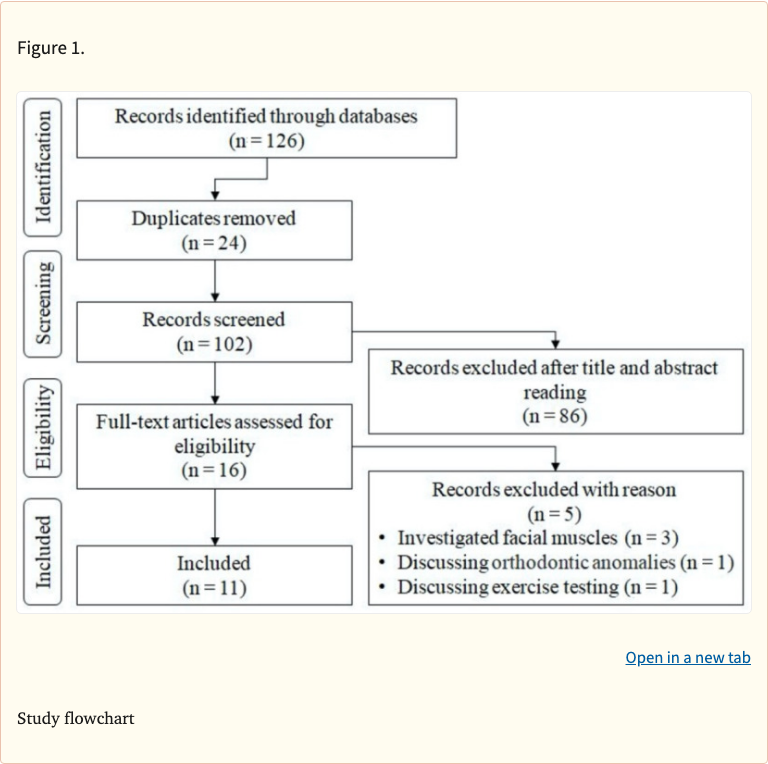 Figure 1
Limitations
- Most studies involved healthy individuals only
- Heterogeneous study designs and age ranges
- Small total number of included studies (n=11)
- Limited clinical population data
- No meta-analysis possible due to study heterogeneity