
Key Takeaway
Upper airway resistance during sleep is 2.4x higher with oral breathing than nasal breathing, and obstructive apneas are nearly 30x more frequent with mouth breathing.
Summary
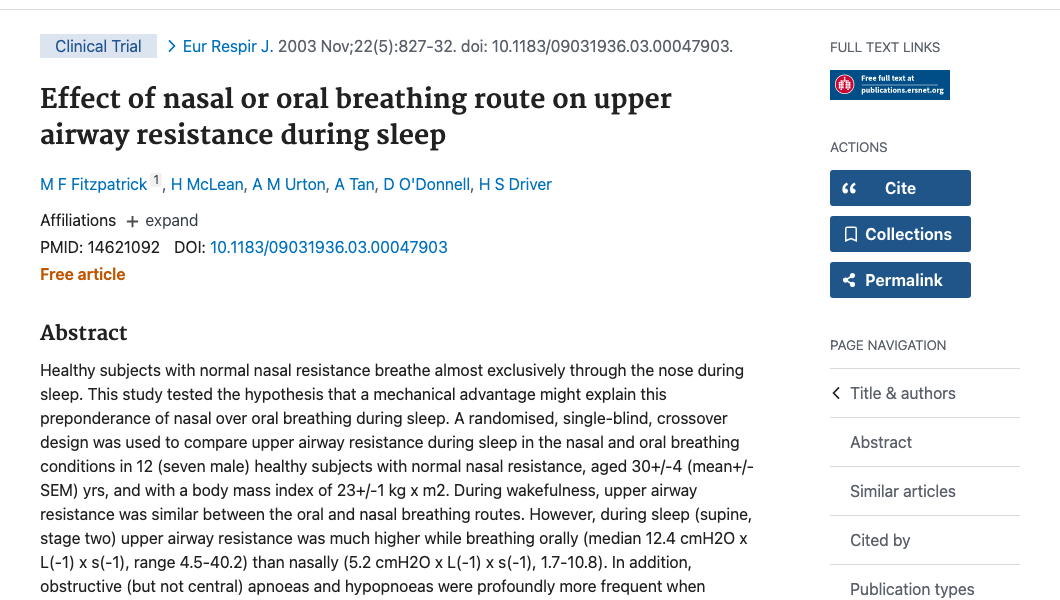
This randomized, single-blind crossover study directly compared upper airway resistance during sleep between nasal and oral breathing routes in 12 healthy subjects with normal nasal resistance. The study provides some of the strongest evidence for why healthy humans predominantly breathe through the nose during sleep.
During wakefulness, upper airway resistance was similar regardless of breathing route. However, during stage two sleep in the supine position, oral breathing produced dramatically higher airway resistance (median 12.4 cmH2O/L/s) compared to nasal breathing (5.2 cmH2O/L/s). Even more striking, obstructive apneas and hypopneas were profoundly more frequent during oral breathing (apnea-hypopnea index of 43) versus nasal breathing (AHI of 1.5).
These findings demonstrate that nasal breathing provides a clear mechanical advantage during sleep, keeping the upper airway more patent and dramatically reducing the frequency of obstructive breathing events. This explains the physiological basis for why mouth breathing during sleep is associated with snoring and obstructive sleep apnea.
Methods
- Randomized, single-blind, crossover design
- 12 healthy subjects (7 male), mean age 30 years, BMI 23 kg/m2
- All subjects had normal nasal resistance
- Compared upper airway resistance during nasal vs oral breathing
- Measured during both wakefulness and stage two sleep (supine)
- Recorded apnea-hypopnea index for each breathing condition
Key Results
- During wakefulness: airway resistance similar between routes
- During sleep (oral): median resistance 12.4 cmH2O/L/s (range 4.5-40.2)
- During sleep (nasal): median resistance 5.2 cmH2O/L/s (range 1.7-10.8)
- Oral breathing resistance 2.4x higher than nasal during sleep
- Obstructive AHI with oral breathing: 43 +/- 6
- Obstructive AHI with nasal breathing: 1.5 +/- 0.5
- Central apneas showed no difference between conditions
Limitations
- Small sample size (n=12)
- Only healthy subjects with normal nasal resistance studied
- May not generalize to those with nasal obstruction
- Single-night measurements
- Only stage two sleep examined