
Key Takeaway
A 12-week RCT found slow breathing significantly reduces psychological stress, though extending the exhale longer than the inhale did not produce additional measurable benefits over equal-ratio breathing.
Summary
This randomized, single-blinded trial tested a key assumption behind cyclic sighing and many breathing techniques: that extending the exhale relative to the inhale produces greater stress reduction than equal-ratio breathing. One hundred healthy adults were randomized to either yoga-based slow breathing with exhale longer than inhale or slow breathing with equal inhale-exhale duration, practiced over 12 weeks.
Both groups showed significant reductions in psychological stress, confirming that slow breathing itself is an effective stress intervention. However, the extended exhale group did not show statistically greater benefits than the equal-ratio group on the primary stress outcomes. This is a nuanced finding - it suggests that the slow breathing rate (~6 breaths/min) may be the primary driver of benefit, with the exhale extension providing a secondary or subtler effect.
For cyclic sighing specifically, this study suggests that the overall slow pace and the deliberate, controlled nature of the breathing pattern may matter more than the precise inhale-to-exhale ratio. That said, the double inhale in cyclic sighing serves a distinct physiological purpose (alveolar reinflation) beyond just timing, which this study did not test.
Methods
- 12-week randomized, single-blinded trial
- 100 healthy adult participants
- Two conditions: extended exhale (exhale > inhale) vs. equal ratio (exhale = inhale)
- Both groups practiced yoga-based slow breathing
- Primary outcome: Perceived Stress Scale (PSS)
- Secondary outcomes: physiological stress markers, anxiety measures
- Assessments at baseline, 6 weeks, and 12 weeks
Key Results
- Both groups showed significant reductions in psychological stress over 12 weeks
- No statistically significant difference between extended exhale and equal ratio groups on primary stress outcome
- The slow breathing rate itself (~6 breaths/min) was effective regardless of ratio
- Adherence was good in both groups
- Benefits were maintained through the 12-week study period
Figures
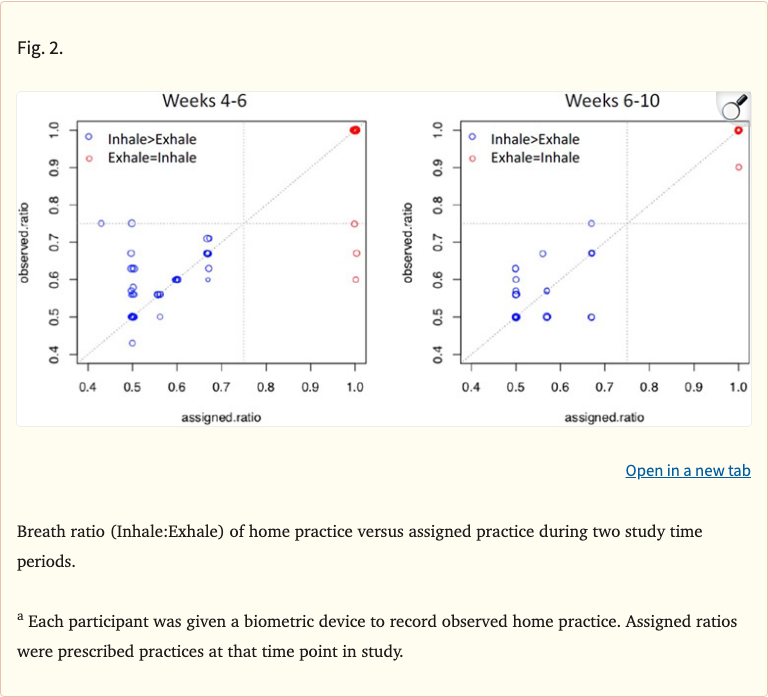 Figure 1
Limitations
- Conducted in healthy adults only (not clinical stress/anxiety populations)
- Did not include a no-breathing control group (cannot separate expectation effects from breathing effects)
- Self-reported stress measures may not capture full physiological picture
- Did not test cyclic sighing specifically (double inhale pattern)
- 12-week duration may not capture longer-term adaptations
- Sample size may have been underpowered to detect subtle ratio differences
