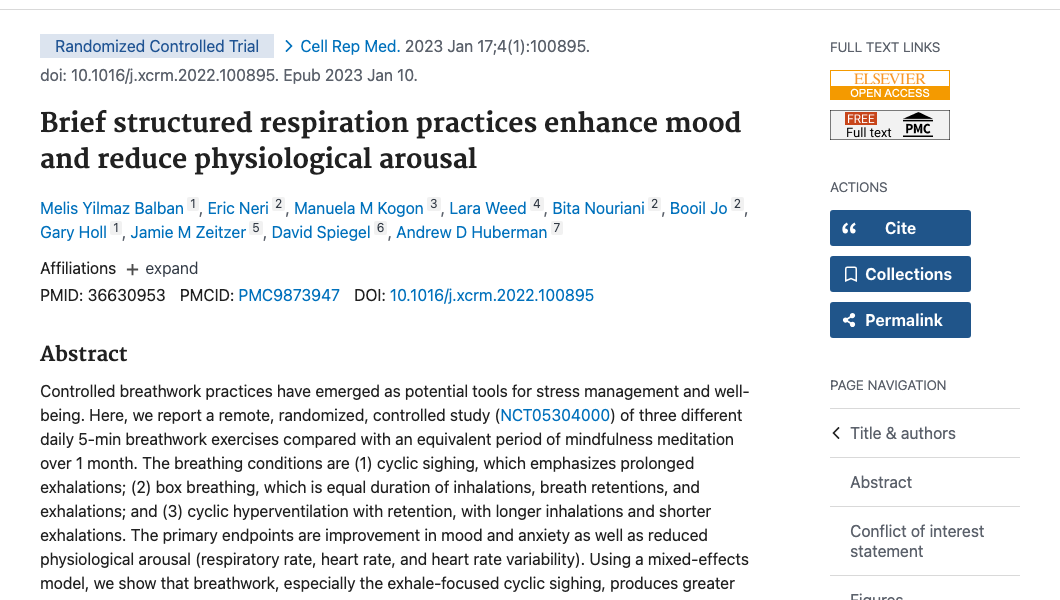
Key Takeaway
A randomized controlled trial showing 5 minutes of daily cyclic sighing (physiological sigh) reduces anxiety and improves mood more effectively than meditation.
Summary
This landmark Stanford study compared four brief daily practices for stress reduction: cyclic sighing (double inhale, long exhale), box breathing, cyclic hyperventilation, and mindfulness meditation.
After 28 days of 5-minute daily practice, cyclic sighing produced the greatest improvements in positive affect, anxiety reduction, and respiratory rate reduction. All three breathwork conditions outperformed mindfulness meditation for mood improvement, but cyclic sighing was superior to the other breathwork techniques.
The study provides strong evidence for the "physiological sigh" as a simple, effective intervention for stress and mood regulation, with effects seen in both subjective reports and physiological measures.
Methods
- 114 participants randomized to 4 conditions
- 5 minutes daily practice for 28 days
- Daily mood and anxiety assessments
- Physiological measures (respiratory rate, HRV)
- Conditions: cyclic sighing, box breathing, cyclic hyperventilation, mindfulness meditation
Key Results
- Cyclic sighing showed greatest improvement in positive affect
- All breathwork conditions reduced anxiety more than meditation
- Cyclic sighing produced greatest respiratory rate reduction
- Effects increased with more practice (dose-response relationship)
- Benefits persisted throughout the day, not just during practice
Limitations
- 28-day study duration (long-term effects unknown)
- Self-reported outcomes for some measures
- Primarily healthy adults (generalizability to clinical populations unclear)
- Meditation condition may not represent optimal meditation practice
Related Interventions
Related Studies
Discussed In

How to Breathe Correctly for Optimal Health, Mood, Learning & Performance
Huberman Lab
Tools for Managing Stress & Anxiety
Huberman Lab
Build Muscle & Strength & Forge Your Life Path | Dorian Yates
Huberman Lab
Essentials: Breathing for Mental & Physical Health & Performance | Dr. Jack Feldman
Huberman Lab
Essentials: Erasing Fears & Traumas Using Modern Neuroscience
Huberman Lab
Essentials: Using Your Nervous System to Enhance Your Immune System
Huberman Lab
Science & Health Benefits of Belief in God & Religion | Dr. David DeSteno
Huberman Lab
Why Breathwork Feels Like a Euphoric Drug | Biohacker Tips : 1369
The Human Upgrade
Essentials: How to Control Your Sense of Pain & Pleasure
Huberman Lab
Essentials: Improving Health With Stronger Brain-Body Connection
Huberman Lab

Jill Miller: Increase Flexibility & Relieve Pain with Breathwork & Myofascial Release
Perform with Dr. Andy Galpin
Enhance Your Physical & Mental Resilience (HRV, Respiratory Rate, RHR)
Perform with Dr. Andy Galpin
Essentials: Boost Your Energy & Immune System with Cortisol & Adrenaline
Huberman Lab
Essentials: Control Pain & Heal Faster With Your Brain
Huberman Lab
Essentials: Tools for Managing Stress & Anxiety
Huberman Lab

SCP Podcast Mini Series, Episode 42: Easy Breathing for Chillaxing and Relaxing
Stop Chasing Pain

Dr Jay Wiles - A Masterclass in Improving Your HRV
Modern Wisdom
Dr David Spiegel - Hypnosis, Brain Hacking, & Mental Mastery
Modern Wisdom
Dr Andrew Huberman - The Secret Tools To Hack Your Brain
Modern Wisdom
#1049 - Dr Jay Wiles - A Masterclass in Improving Your HRV
Modern Wisdom
The Wim Hof Method - with Wim Hof| EP 108
The Empowering Neurologist Podcast
How to Use Cold Therapy and Breathwork to Prevent Disease and Stagnation with Wim Hof
Dhru Purohit Show

Wim Hof, The Iceman: Hack Your Biochemistry | E175
Young and Profiting with Hala Taha (Entrepreneurship, Sales, Marketing)

Wim Hof
Happy Place

Wim Hof
Live Life Better with Scott Eastwood

Episode 595: Wim Hof: The Iceman
Sofa King Podcast

Wim Hof ON: The One Simple Method To Improve Your Focus, Strength and Confidence
On Purpose with Jay Shetty
You're Breathing Wrong: The Buteyko Breathing Method
The Holistic Navigator

192: Buteyko Breathing - Is C02 Your Friend?
Age Less / Live More

S4 EP76: FROZEN SAMMIES AND BOX BREATHING
THE UPSIDE with Callie and Jeff Dauler
Box Breathing
Healing Meditation for Women

Box Breathing Athletes
Healthy Mindset App Podcast
114: Don't Forget to Breathe
Time to Pivot
Tactical Tip Tuesday - Microcast 22
The Guns & Yoga Podcast

Ep. 25: Training While Sick & Breathing
Dialed Health

Soma Breath’s Journey to Success - Niraj Naik
The Jason Marc Campbell Business Podcast

Efficiency with Breath: Niraj Naik on SOMA Breathing PH289
Pursuing Health

Niraj Naik: SOMA Breath For Less Stress
Wellness + Wisdom Podcast

337: Power of the Breath with Niraj Naik
I AM HUMAN

NLS 584: RENEGADE Pharmacist DISCOVERS NATURAL Way to INDUCE a Near-Death Experience NDE At WILL with Niraj Naik
Next Level Soul Podcast with Alex Ferrari

Live Longer with Conscious (SOMA) Breathwork
P.S. Younger Self

367: Hold Your Breath
Wise Traditions

Ep64 - Niraj Naik: The Healing Power of Breath Work
HIListically Speaking with Hilary Russo

SUPERNATURAL BREATHING! CHANGE YOUR BREATH TO CHANGE YOUR LIFE! Niraj Naik
Inspire Nation Show with Michael Sandler

#641 - Breathing Expert James Nestor
This Past Weekend w/ Theo Von