
Key Takeaway
Largest meta-analysis on slow breathing (223 studies) confirms it reliably increases vagally-mediated heart rate variability during practice, immediately after, and after multi-session interventions.
Summary
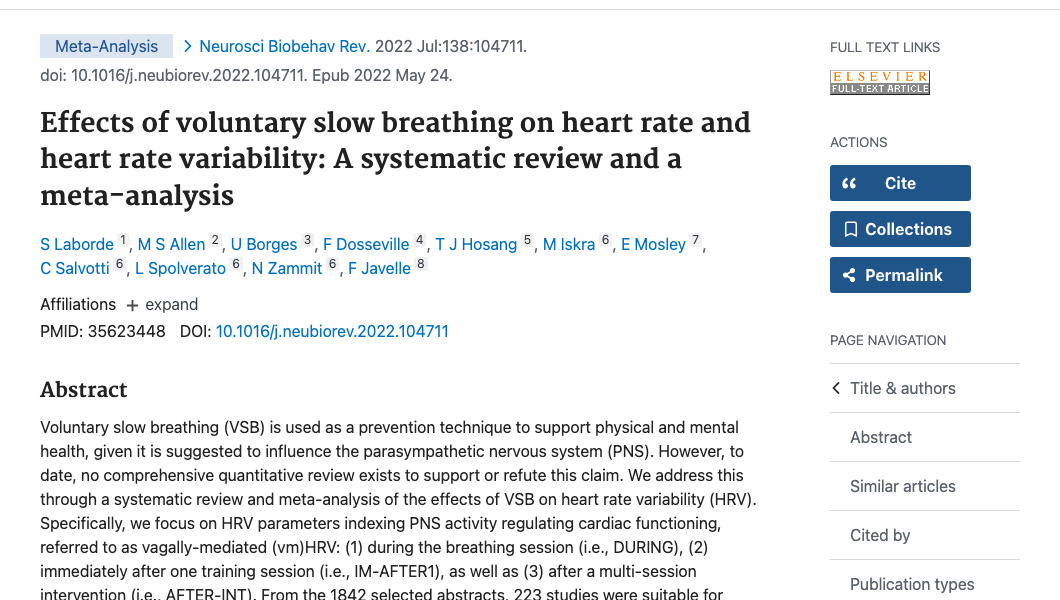
This comprehensive systematic review and meta-analysis examined the effects of voluntary slow breathing (VSB) on heart rate variability, the gold-standard measure of parasympathetic nervous system activity. From 1,842 screened abstracts, 223 studies met inclusion criteria, making it the largest meta-analysis on the topic.
The analysis examined three timepoints: during slow breathing sessions, immediately after a single session, and after multi-session interventions (weeks of practice). At all three timepoints, slow breathing significantly increased vagally-mediated HRV (vmHRV), indicating enhanced parasympathetic activation. The effects were most pronounced during actual breathing practice but persisted afterward.
These findings provide the physiological foundation for why cyclic sighing and other slow breathing techniques work: they shift the autonomic nervous system toward parasympathetic dominance. The extended exhale in cyclic sighing is particularly effective because it maximizes the respiratory sinus arrhythmia window, where heart rate naturally slows during exhalation. The dose-response pattern (more sessions = greater lasting benefits) mirrors what was found in the Balban 2023 cyclic sighing trial.
Methods
- Systematic review following PRISMA guidelines
- Searched PubMed, PsycINFO, Web of Science, and Scopus databases
- 1,842 abstracts screened, 223 studies included in meta-analysis
- Focused on vagally-mediated HRV (vmHRV) as primary outcome
- Analyzed effects at three timepoints: during, immediately post, and after multi-session interventions
- Included studies of various slow breathing techniques (~6 breaths/min typical)
Key Results
- Voluntary slow breathing significantly increased vmHRV during practice sessions
- Immediate post-session increases in vmHRV were also significant
- Multi-session interventions (weeks of practice) produced lasting vmHRV improvements
- Effects were consistent across different slow breathing protocols
- Breathing at approximately 6 breaths per minute showed strongest parasympathetic activation
- Heart rate decreased during slow breathing across studies
Limitations
- Heterogeneity across studies in breathing protocols, durations, and populations
- Most studies used healthy adult participants (limited clinical population data)
- Publication bias possible given large number of positive findings
- Does not specifically isolate cyclic sighing from other slow breathing methods
- Long-term follow-up (months/years) data still limited
