Key Takeaway
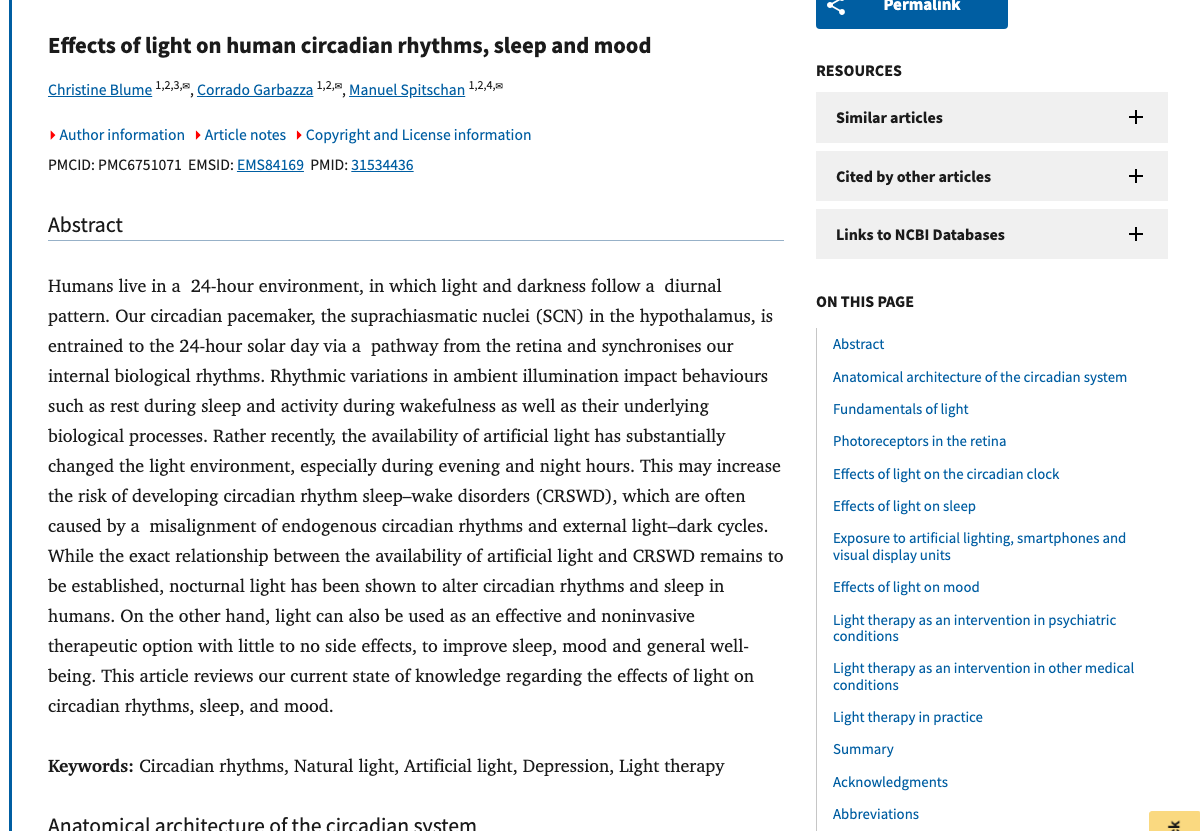
Comprehensive review establishing that light exposure is the dominant environmental signal regulating human circadian rhythms, sleep timing, and mood, with morning light playing a critical role in phase-advancing the circadian clock.
Summary
This comprehensive review synthesizes the scientific literature on how light affects three interconnected aspects of human health: circadian rhythms, sleep, and mood. The authors trace the pathway from light detection in the retina through intrinsically photosensitive retinal ganglion cells (ipRGCs) to the suprachiasmatic nucleus (SCN) and downstream hormonal and behavioral effects.
The review establishes that light is the most powerful zeitgeber (time-giver) for the human circadian system. Morning light exposure phase-advances the circadian clock, promoting earlier sleep onset and wake times, while evening light delays the clock. The authors detail how the intensity, timing, duration, and spectral composition of light all influence circadian entrainment, with brighter and shorter-wavelength (blue-enriched) light having the strongest effects.
The paper also examines therapeutic applications of light, particularly for seasonal affective disorder (SAD), non-seasonal depression, and circadian rhythm sleep-wake disorders. Light therapy, typically using 10,000 lux bright light boxes in the morning, is well-established as an effective treatment for these conditions. The review highlights that modern indoor lifestyles expose people to insufficient daytime light and excessive evening light, creating a mismatch with evolutionary circadian biology that contributes to sleep disruption and mood disorders.
Methods
- Narrative review of published literature on light, circadian rhythms, sleep, and mood
- Covers basic science of phototransduction and circadian biology
- Reviews clinical studies on light therapy for SAD and sleep disorders
- Examines spectral sensitivity of the circadian system (melanopsin, ipRGCs)
- Synthesizes evidence on timing, intensity, and duration of light exposure effects
- Discusses modern light environments and their impact on circadian health
Key Results
- Light is the dominant zeitgeber for the human circadian system, more powerful than social cues or meal timing
- Morning light exposure phase-advances the circadian clock, promoting earlier and more consistent sleep timing
- Evening light exposure phase-delays the clock and suppresses melatonin
- Outdoor daylight provides 10,000-100,000 lux vs. typical indoor lighting of 100-500 lux
- 10,000 lux morning light therapy is effective for SAD (response rates 50-80%)
- Light therapy also benefits non-seasonal depression, with effect sizes comparable to antidepressants
- Short-wavelength (blue-enriched) light has the strongest circadian effects due to melanopsin sensitivity
- Modern indoor lifestyles create chronic circadian disruption through insufficient daytime and excessive evening light
Figures
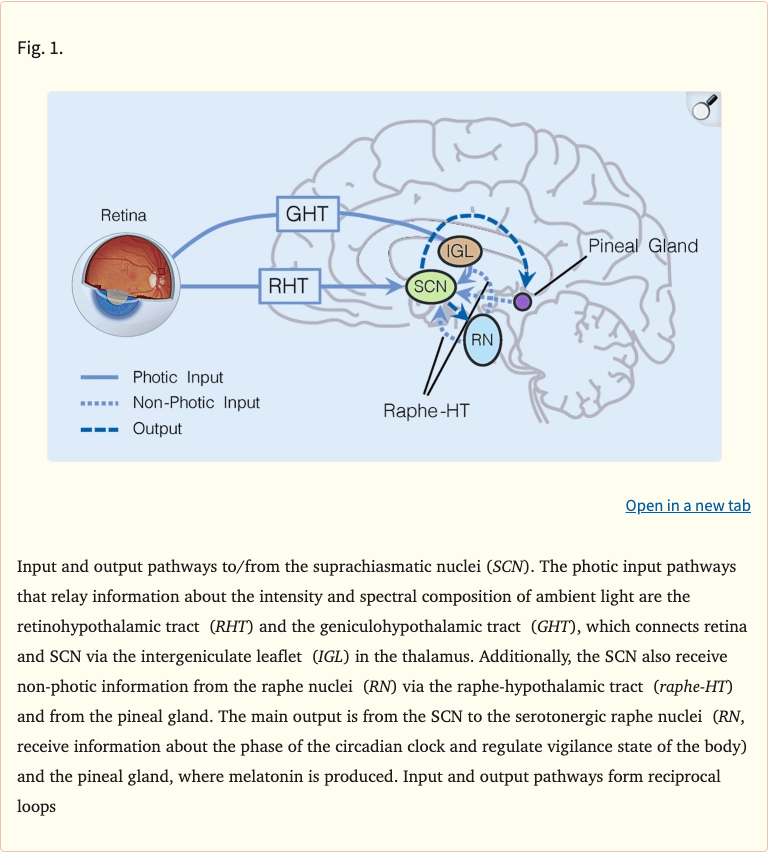 Figure 1
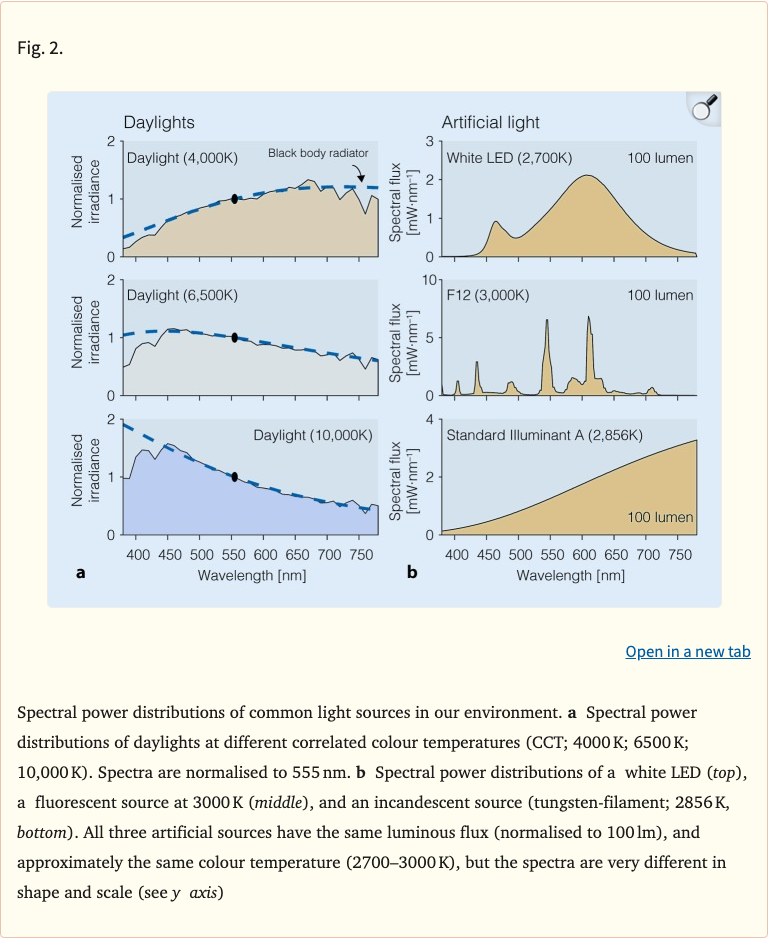 Figure 2
Limitations
- Narrative review rather than systematic review or meta-analysis, introducing potential selection bias in studies covered
- Does not provide pooled quantitative effect sizes across studies
- Rapid pace of research means some newer findings may not be included
- Individual variability in light sensitivity is acknowledged but not deeply explored
- Limited discussion of practical barriers to implementing light exposure recommendations
- Some therapeutic recommendations extrapolated from controlled settings to real-world conditions
Related Interventions
Related Studies
Discussed In