
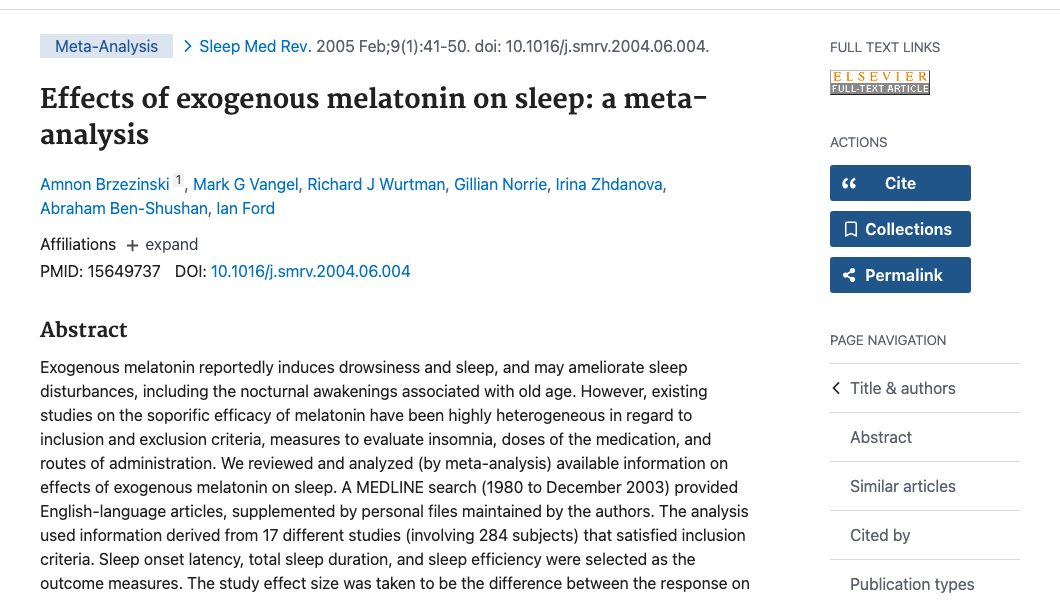
Key Takeaway
Exogenous melatonin significantly decreases sleep onset latency, increases sleep efficiency, and increases total sleep duration with no evidence of tolerance or dependency.
Summary
This meta-analysis from MIT and other institutions examined 17 controlled studies to determine the effects of exogenous melatonin on sleep parameters. The study included prominent melatonin researcher Richard Wurtman among its authors.
The analysis provided strong evidence for melatonin's efficacy across multiple sleep parameters and importantly found no evidence of tolerance development or withdrawal effects with continued use.
Methods
- Meta-analysis of 17 controlled studies
- 284 subjects in melatonin groups, 273 in placebo groups
- Studies included single-dose and repeated administration
- Weighted mean differences calculated
- Subgroup analysis by study design
Key Results
- Sleep onset latency decreased by 4.0 minutes (p=0.001)
- Sleep efficiency increased by 2.2% (p=0.001)
- Total sleep duration increased by 12.8 minutes (p=0.001)
- Effects consistent in older and younger adults
- No evidence of tolerance with repeated use
- No withdrawal effects reported
- Larger effects in people with delayed sleep phase
Limitations
- Included studies with various doses and timing
- Some heterogeneity in study populations
- Limited long-term follow-up data
- Most studies in controlled laboratory settings
- Publication bias possible
Related Interventions
Related Studies
Discussed In
#107 Why You Can't Sleep (and How to Fix It) | Dr. Michael Grandner
FoundMyFitness
#065 Dr. Satchin Panda on Circadian Insights into Exercise Timing, Melatonin Biology, and Peak Cognition
FoundMyFitness

Dr. Matthew Walker — The Hidden Dangers of Melatonin, Tools for Insomnia, Sleep Spindles, and Lucid Dreaming
The Tim Ferriss Show

Dr Matthew Walker - The Science Of Perfect Sleep
Modern Wisdom

The Best Way To Use Hydrogen For Health, Finding A Good Hormone Doctor, Why Alcohol ISN'T Always Bad For You (But Weed Might Be!) & More Solosode 496
Ben Greenfield Life
Melatonin the Masterful Molecule for Mitochondria with Dr Russel Reiter
Mitolife Radio