Key Takeaway
Melatonin's sleep-promoting effects peak at 4 mg/day and are optimized when taken 3 hours before desired bedtime rather than the conventional 30 minutes before bed.
Summary
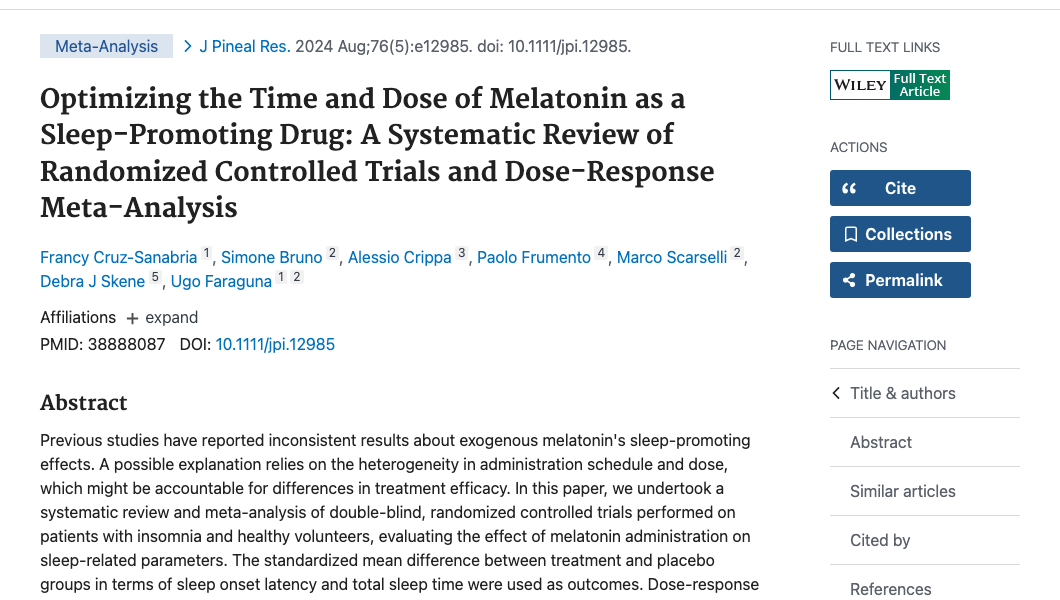
This systematic review and dose-response meta-analysis of 26 RCTs (1,689 observations) investigated the optimal dose and timing of melatonin for sleep promotion in both insomnia patients and healthy volunteers. The analysis covered trials from 1987 to 2020.
The key finding was that melatonin gradually reduces sleep onset latency and increases total sleep time, with effects peaking at 4 mg/day. Crucially, the timing of administration significantly predicted outcomes: taking melatonin 3 hours before the desired bedtime and at a dose of 4 mg/day outperformed the standard practice of 2 mg taken 30 minutes before bed.
This study provides actionable dosing guidance that challenges common practice, suggesting many people may benefit from both a higher dose and earlier administration than typically recommended.
Methods
- Systematic review of randomized controlled trials (1987-2020)
- 26 RCTs included with 1,689 observations
- Dose-response meta-analysis methodology
- Populations: insomnia patients and healthy volunteers
- Outcomes: sleep onset latency and total sleep time
- Assessed timing of administration and dose as predictors
Key Results
- Sleep-promoting effects peak at 4 mg/day
- Timing between administration and sleep significantly predicted sleep onset latency (beta = -0.16, p = 0.023)
- Time of day was the only significant predictor of total sleep time (beta = -0.086, p < 0.01)
- 3 hours before desired bedtime outperforms 30 minutes before bed
- Insomnia diagnosis was a significant predictor of sleep onset latency outcomes
- Dose of 4 mg combined with earlier administration optimizes effects vs. standard 2 mg at 30 min
Limitations
- Heterogeneity in study designs and populations
- Combined insomnia patients with healthy volunteers
- Limited studies at doses above 5 mg
- Most trials had relatively short durations
- Individual variability in melatonin metabolism not accounted for
- Optimal timing may vary by circadian chronotype
Related Interventions
Related Studies
Discussed In