
Key Takeaway
Systematic review showing HIIT significantly reduces both systolic and diastolic blood pressure in older adults (60+), with effects comparable to moderate-intensity continuous training.
Summary
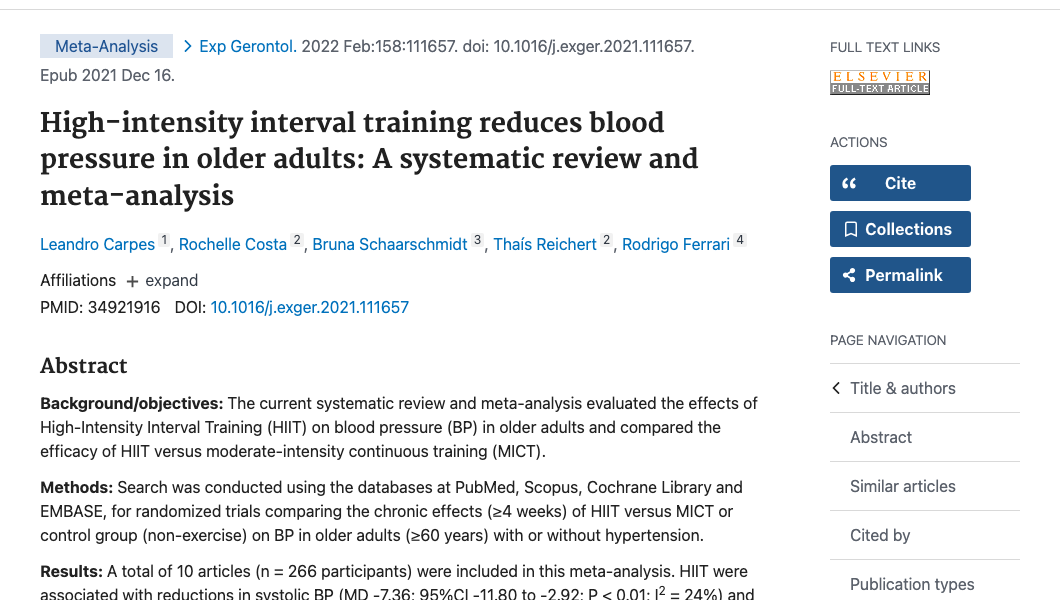
This systematic review and meta-analysis examined the chronic effects of HIIT on blood pressure in older adults aged 60 and above. The researchers searched PubMed, Scopus, Cochrane Library, and EMBASE for randomized trials lasting at least 4 weeks comparing HIIT to either moderate-intensity continuous training (MICT) or non-exercise controls.
Ten articles with 266 total participants were included. Compared to non-exercise controls, HIIT was associated with clinically meaningful reductions in systolic blood pressure (mean difference -7.36 mmHg, p < 0.01) and diastolic blood pressure (mean difference -5.48 mmHg, p < 0.01). When compared directly to MICT, no significant differences were found for either systolic or diastolic blood pressure, suggesting both approaches are equally effective.
These findings are particularly relevant for aging populations, where hypertension is a major contributor to cardiovascular disease and mortality. The results support HIIT as a safe and effective alternative to traditional moderate-intensity exercise for blood pressure management in older adults, offering the added benefit of time efficiency.
Methods
- Systematic review and meta-analysis
- Databases: PubMed, Scopus, Cochrane Library, EMBASE
- Inclusion: RCTs, participants aged 60+, HIIT interventions lasting 4+ weeks
- Comparisons: HIIT vs non-exercise control, HIIT vs MICT
- 10 articles, 266 participants total
Key Results
- HIIT vs control: systolic BP reduced by 7.36 mmHg (p < 0.01, I-squared = 24%)
- HIIT vs control: diastolic BP reduced by 5.48 mmHg (p < 0.01, I-squared = 40%)
- HIIT vs MICT: no significant difference in systolic BP (MD -2.09, p = 0.59)
- HIIT vs MICT: no significant difference in diastolic BP (MD -1.00, p = 0.69)
- Low heterogeneity across studies for most comparisons
Limitations
- Relatively small total sample size (266 participants across 10 studies)
- Limited to adults aged 60+, may not generalize to younger populations
- Varying HIIT protocols across included studies
- Short to moderate intervention durations
- Could not assess long-term blood pressure maintenance effects