
Key Takeaway
Home-based transcranial and intranasal photobiomodulation improved cognitive function, reduced neuropsychiatric symptoms, and increased cerebral perfusion in dementia patients over 12 weeks
Summary
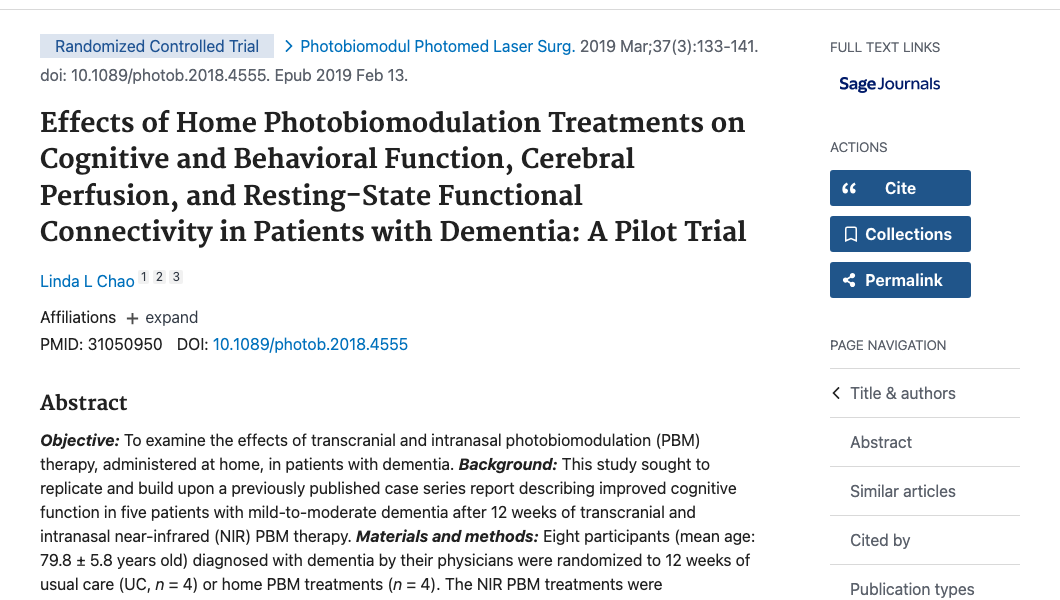
This randomized controlled pilot trial from UCSF tested whether home-based photobiomodulation could improve cognitive and behavioral function in dementia patients. Eight participants (mean age ~80) were randomized to either 12 weeks of PBM treatment or usual care.
The PBM group used the Vielight Neuro Gamma device (transcranial + intranasal NIR) three times per week at home, administered by a study partner. After 12 weeks, the treatment group showed significant improvements on cognitive and behavioral measures, along with increased cerebral perfusion and enhanced default-mode network connectivity. The treatment was well tolerated with no adverse effects.
Methods
- Randomized controlled pilot trial
- 8 participants with physician-diagnosed dementia (mean age 79.8)
- Randomized to PBM treatment (n=4) or usual care (n=4)
- Vielight Neuro Gamma device (transcranial + intranasal, 810nm, 40Hz pulsed)
- 12-week treatment, 3 sessions per week at home
- Cognitive assessments (ADAS-cog), neuropsychiatric inventory (NPI)
- Arterial spin labeling MRI for cerebral perfusion
- Resting-state fMRI for functional connectivity
Key Results
- Significant improvement on ADAS-cog (cognitive function) vs. usual care
- Significant improvement on NPI (behavioral/neuropsychiatric symptoms)
- Increased cerebral perfusion in the PBM group
- Enhanced functional connectivity between posterior cingulate cortex and lateral parietal regions (default-mode network)
- No adverse side effects reported
- Treatment was well tolerated by all participants
Limitations
- Very small sample size (n=8, only 4 per group)
- Pilot study requiring larger replication
- No sham/placebo control (usual care comparator)
- Participants and study partners not blinded
- 12-week duration limits understanding of long-term effects
- Single-site study (UCSF)