
Key Takeaway
Comprehensive review confirms PMR effectively reduces anxiety symptoms, though the exact mechanisms (muscle tension vs cognitive) remain debated.
Summary
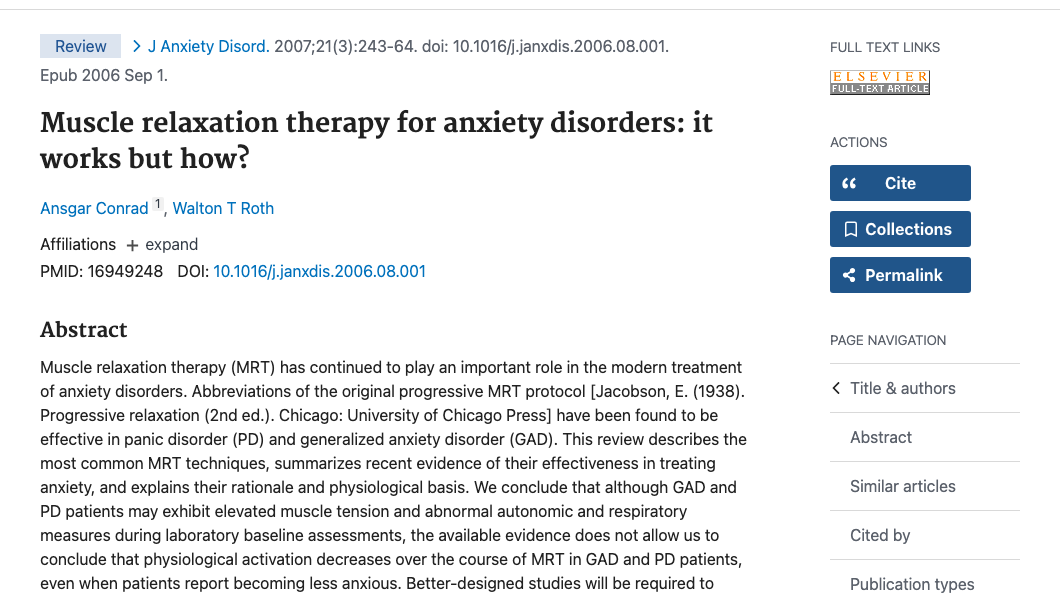
This review examines the evidence for progressive muscle relaxation (PMR) in treating anxiety disorders and explores potential mechanisms of action.
The authors find consistent evidence that PMR reduces anxiety symptoms across multiple disorders including generalized anxiety disorder, panic disorder, and phobias. However, the traditional explanation - that reducing muscle tension reduces anxiety - is challenged by evidence showing cognitive and attentional mechanisms may be equally important.
The review suggests PMR works through multiple pathways including decreased physiological arousal, increased sense of control, and distraction from anxious thoughts.
Methods
- Narrative review of clinical trials and mechanism studies
- Examination of EMG biofeedback studies
- Analysis of dismantling studies comparing components
- Review of psychophysiological correlates
Key Results
- Consistent anxiolytic effects across studies
- Effects comparable to other relaxation techniques
- Muscle tension reduction may not be primary mechanism
- Cognitive and attentional factors contribute significantly
Limitations
- Narrative rather than systematic review
- Limited dismantling studies available
- Mechanisms difficult to isolate experimentally
- Individual differences in response not fully explored