
Key Takeaway
Mouth taping at night had no effect on asthma control in a randomized crossover trial of 50 patients, despite theoretical benefits of forced nasal breathing.
Summary
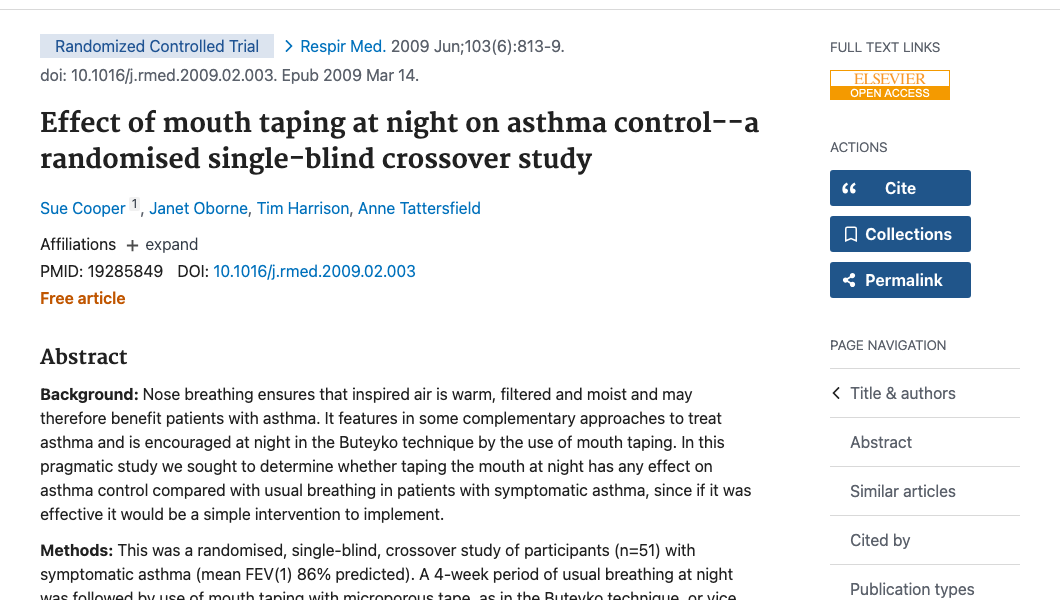
This randomized single-blind crossover trial tested whether mouth taping at night could improve asthma control. The rationale was that nasal breathing warms, filters, and humidifies air — all theoretically beneficial for asthma. 50 participants with symptomatic asthma alternated between 4-week periods of mouth taping with microporous tape and usual breathing, with a washout between.
Compliance was high — median 26 of 28 nights with tape — and 36 of 50 participants rated taping as "very or fairly acceptable." However, the intervention produced no improvements. Morning peak expiratory flow was unchanged (mean difference -1 L/min), symptom scores were identical (mean difference -0.12), and no secondary measures improved.
This is a well-designed null result that suggests mouth taping alone may not be sufficient to improve respiratory conditions, even when the mechanism for nasal breathing benefits is plausible.
Methods
- 50 adults with symptomatic asthma (mean FEV₁ 86% predicted)
- Randomized single-blind crossover design
- 4-week taping periods vs 4-week usual breathing
- 2-week run-in and minimum 2-week washout
- Microporous tape applied at night
Key Results
- Morning peak flow: no difference (mean diff -1 L/min)
- Symptom scores: no difference (mean diff -0.12)
- No improvement in any secondary measure
- High compliance (26/28 nights) and acceptability (72%)
Limitations
- Asthma-specific outcome — does not address sleep quality or snoring
- Participants may not have been mouth breathers at baseline
- 4-week intervention period may be too short for long-term adaptation