
Key Takeaway
Systematic review of 10 studies (213 patients) found mixed evidence for mouth taping — only 2 studies showed significant sleep apnea improvements, while most showed no benefit and flagged safety risks including asphyxiation with nasal obstruction.
Summary
This systematic review searched MEDLINE, Embase, and Google Scholar for studies on mouth taping in patients with mouth breathing, sleep-disordered breathing, or obstructive sleep apnea. From 120 articles screened, 10 met inclusion criteria covering 213 total patients.
Results were mixed. Only two studies demonstrated statistically significant improvements in sleep apnea markers like the apnea-hypopnea index. Most studies showed no benefit. The authors highlighted safety concerns, noting potential risks of asphyxiation in individuals with nasal obstruction. Critically, most studies excluded anyone with nasal obstruction or pathology, meaning the most vulnerable populations were not studied.
The review concluded there is insufficient evidence to recommend mouth taping as a treatment for sleep-disordered breathing and warned of potentially serious harm for people indiscriminately adopting the social media trend.
Methods
- Systematic search of MEDLINE, Embase, and Google Scholar (Feb 1999–Feb 2024)
- 120 articles screened, 10 met inclusion criteria
- 213 total patients across included studies
- Focused on mouth breathing, sleep-disordered breathing, and OSA populations
Key Results
- 2 of 10 studies showed significant improvement in apnea-hypopnea index
- Most studies showed no benefit from mouth taping
- Safety risks documented including asphyxiation risk with nasal obstruction
- Most studies excluded patients with nasal obstruction
Figures
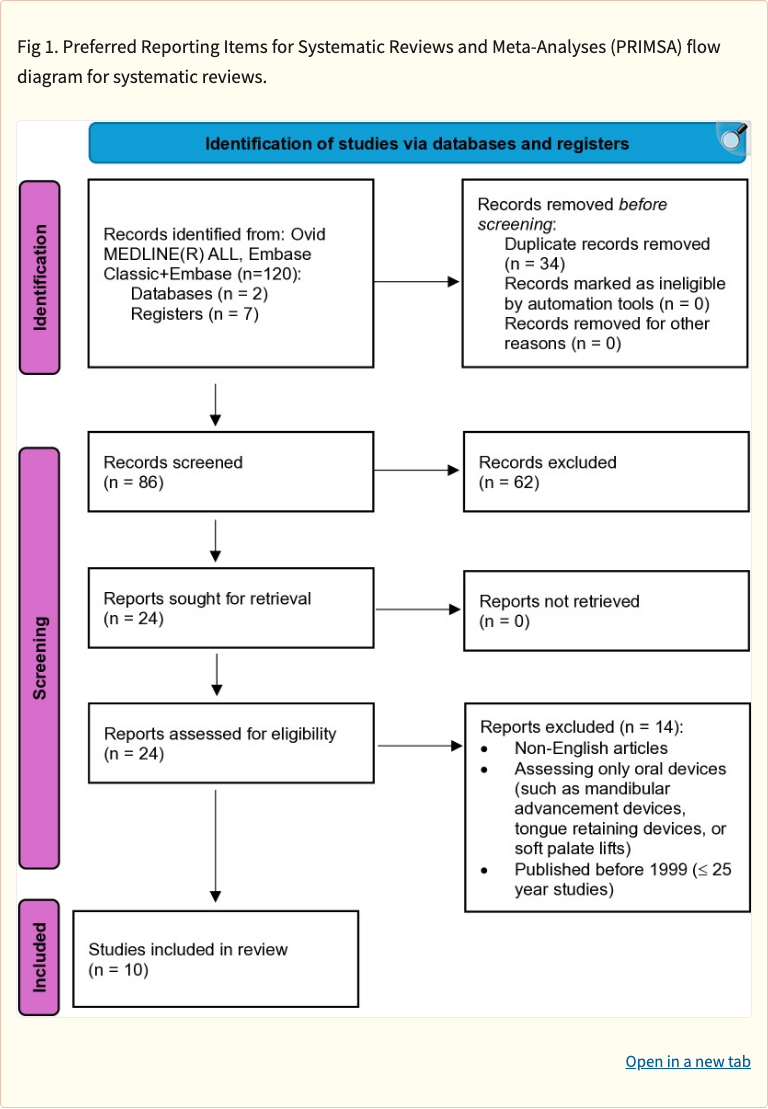 Figure 1
Limitations
- Small total patient pool (213 across 10 studies)
- Heterogeneous study designs and populations
- Most studies excluded nasal obstruction — the highest-risk group