
Key Takeaway
H2O2 acts as an essential cellular messenger at physiological concentrations, but this does not support external H2O2 administration for health benefits.
Summary
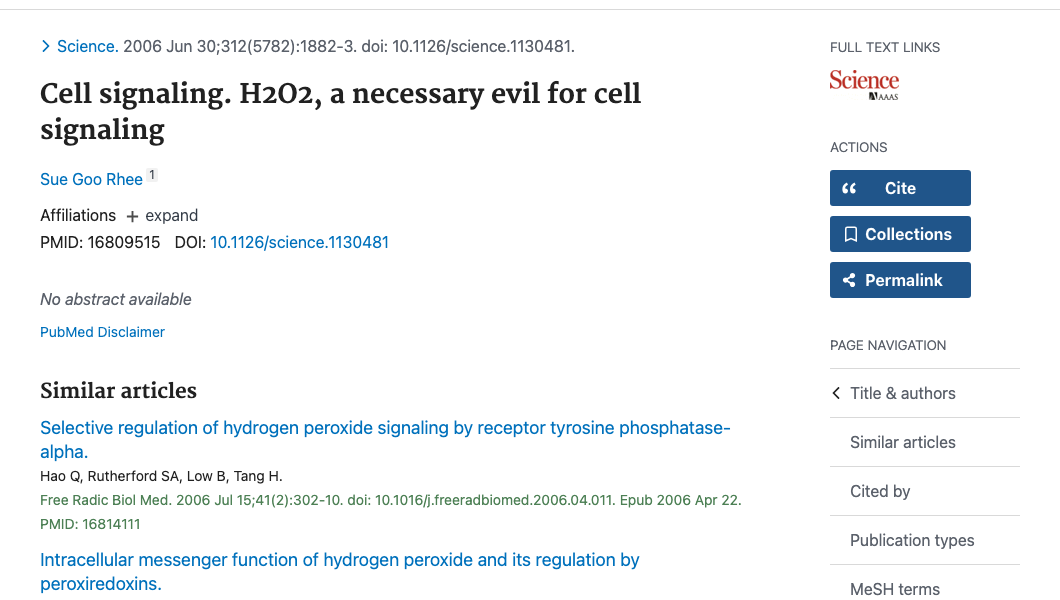
This Science paper reviews the emerging understanding of H2O2 as a signaling molecule.
Key findings:
- H2O2 is not just a toxic byproduct but a signaling molecule
- Cells have sophisticated systems to produce and eliminate H2O2
- Signaling occurs at very low, tightly controlled concentrations
- Peroxiredoxins regulate H2O2 levels for signaling
Signaling mechanisms:
| Target | Effect |
|---|---|
| Protein tyrosine phosphatases | Reversible oxidation (activation) |
| Transcription factors | Redox-sensitive activation |
| Ion channels | Modulation of activity |
| Kinases | Pathway activation |
Critical insight:
The signaling function of H2O2 occurs at nanomolar concentrations with precise spatial and temporal control. Flooding the system with exogenous H2O2 is fundamentally different from this controlled signaling.
Why this matters for therapy claims:
- Natural H2O2 signaling =/= therapeutic H2O2
- Body produces ~50 mmol H2O2/day normally
- Additional H2O2 may overwhelm, not enhance, systems
- No evidence that more is better
Conclusion:
While this paper validates H2O2's biological importance, it actually argues against crude H2O2 therapy by showing how precisely regulated natural H2O2 signaling is.