Key Takeaway
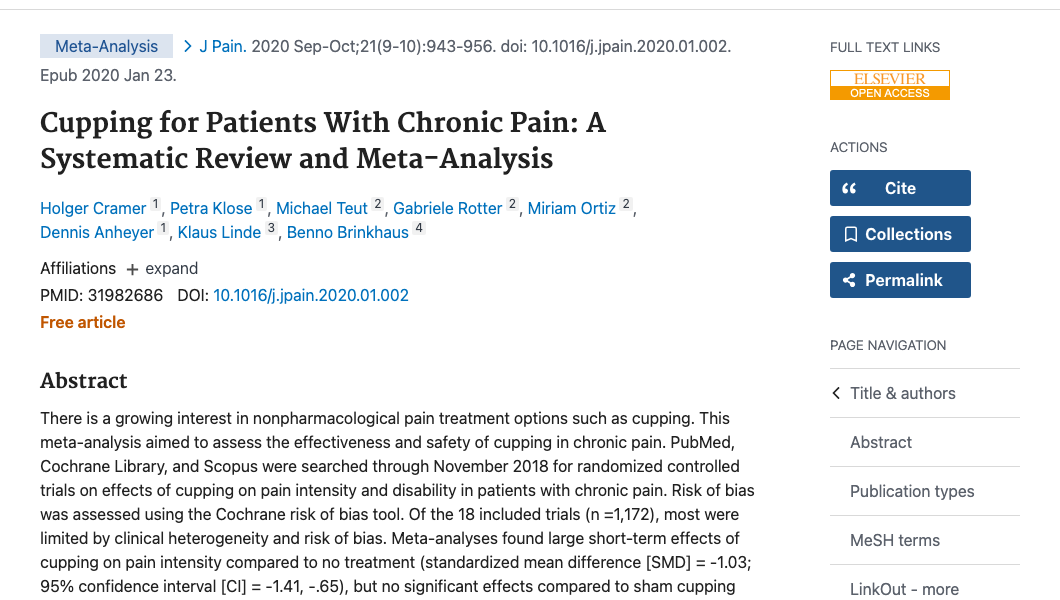
Meta-analysis of 18 RCTs found cupping reduced chronic pain vs no treatment (SMD -1.03) but not vs sham cupping, suggesting possible placebo contribution.
Summary
This systematic review and meta-analysis examined 18 randomized controlled trials involving 1,172 participants with chronic pain conditions. The authors searched PubMed, Cochrane Library, and Scopus through November 2018 for RCTs comparing cupping therapy to control conditions.
The key finding was a distinction between cupping compared to different controls. Against no treatment, cupping showed large short-term pain reductions (SMD = -1.03) and medium improvements in disability (SMD = -0.66). However, when compared to sham cupping, the differences were not statistically significant for either pain (SMD = -0.27) or disability (SMD = -0.26). Against active treatments, cupping showed no significant pain advantage but a small disability benefit.
The authors concluded that while cupping may provide pain relief, the evidence is limited by clinical heterogeneity and risk of bias across included trials. The lack of significant benefit over sham cupping raises questions about how much of the effect is physiological vs placebo. Higher quality trials were recommended to clarify cupping's true therapeutic value.
Methods
- Systematic review and meta-analysis of RCTs
- Searched PubMed, Cochrane Library, and Scopus through November 2018
- Included RCTs of cupping for chronic pain conditions
- 18 trials with 1,172 participants included
- Risk of bias assessed using Cochrane tool
- Outcomes: pain intensity and disability
Key Results
- vs no treatment: large pain reduction (SMD = -1.03), medium disability improvement (SMD = -0.66)
- vs sham cupping: no significant pain difference (SMD = -0.27), no significant disability difference (SMD = -0.26)
- vs active treatments: no significant pain advantage (SMD = -0.24), small disability benefit (SMD = -0.52)
- Adverse events more frequent with cupping than no treatment
Limitations
- Evidence limited by clinical heterogeneity
- High risk of bias in most included trials
- Not significantly better than sham cupping
- Difficult to blind cupping interventions
- Publication bias possible