
Key Takeaway
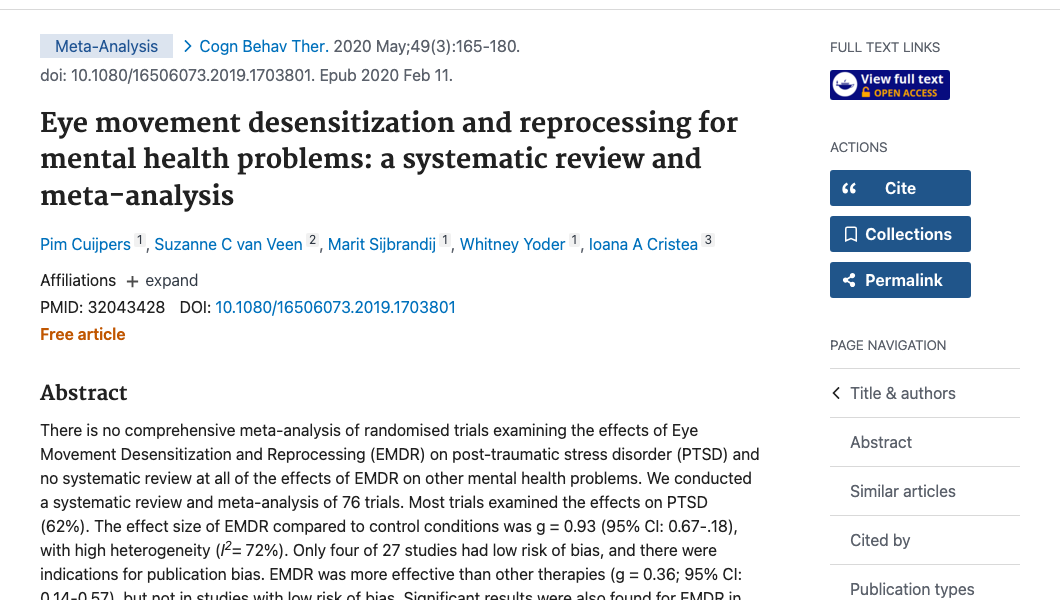
Large meta-analysis of 76 trials found EMDR effective for mental health problems (g = 0.93 vs controls), though superiority over other therapies disappeared in low risk-of-bias studies
Summary
This comprehensive systematic review and meta-analysis included 76 trials examining EMDR for various mental health problems. Most trials (62%) focused on PTSD. EMDR showed large effects compared to control conditions (g = 0.93) and small-to-moderate effects compared to other therapies (g = 0.36). However, the superiority over other therapies was not maintained in studies with low risk of bias.
Methods
Systematic review and meta-analysis of 76 trials. Majority examined PTSD (62%). Compared EMDR to control conditions and active therapies. Risk of bias assessed. Subgroup analyses by study quality. Effect sizes calculated using Hedges' g.
Key Results
EMDR vs controls: g = 0.93 (95% CI: 0.67-1.18), high heterogeneity (I² = 72%). EMDR vs other therapies: g = 0.36 (95% CI: 0.14-0.57). In low risk-of-bias studies, superiority over other therapies was not significant.
Limitations
High heterogeneity across studies (I² = 72%). Effect over other therapies disappeared in high-quality studies. Most studies focused on PTSD. Variable EMDR protocols. Many studies had small samples. Publication bias likely.