Key Takeaway
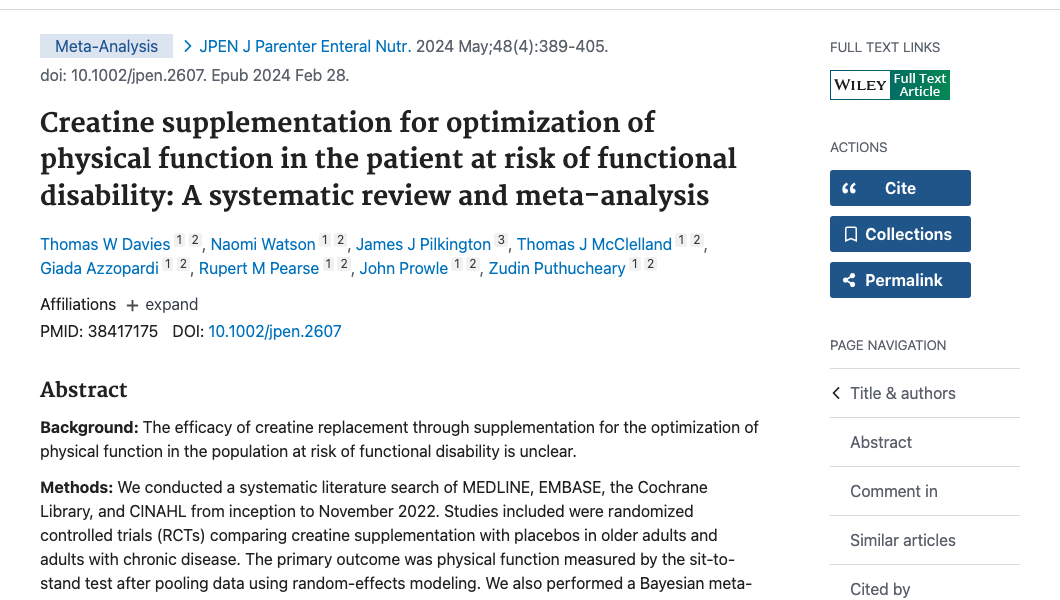
Creatine supplementation improved sit-to-stand performance (SMD 0.51), upper-body strength (SMD 0.25), handgrip strength (SMD 0.23), and lean tissue mass (+1.08 kg) in populations at risk of functional disability.
Summary
This systematic review and meta-analysis evaluated the efficacy of creatine supplementation for improving physical function in populations at risk of functional disability, including older adults and adults with chronic disease. The review searched four major databases from inception to November 2022 and identified 33 randomized controlled trials comprising 1,076 participants.
The primary outcome was sit-to-stand performance, which showed a moderate improvement with creatine supplementation (SMD 0.51, 95% CI: 0.01–1.00). A Bayesian analysis estimated a 66.7% posterior probability that creatine supplementation improves physical function. Secondary outcomes also favored creatine, with significant improvements in upper-body muscle strength, handgrip strength, and lean tissue mass (an increase of 1.08 kg).
This meta-analysis is particularly relevant because it focuses on clinical populations who stand to benefit most from functional improvements, including older adults and those with chronic conditions. The authors note that while the findings are promising, the overall quality of evidence was low to very low due to high risk of bias in many included studies, and they call for high-quality prospective RCTs to confirm these results.
Methods
Systematic review and meta-analysis of 33 RCTs (1,076 participants) comparing creatine supplementation with placebo in older adults and adults with chronic disease. Searched MEDLINE, EMBASE, Cochrane Library, and CINAHL from inception to November 2022. Used random-effects modeling for pooled analyses and Bayesian meta-analysis with weakly informative priors. Risk of bias assessed using the Cochrane risk-of-bias tool.
Key Results
Primary outcome (sit-to-stand test): SMD 0.51 (95% CI: 0.01–1.00; I² = 62%; P = 0.04). Bayesian posterior probability of benefit: 66.7%. Upper-body muscle strength: SMD 0.25 (95% CI: 0.06–0.44; I² = 0%). Handgrip strength: SMD 0.23 (95% CI: 0.01–0.45; I² = 0%). Lean tissue mass: MD 1.08 kg (95% CI: 0.77–1.38; I² = 26%).
Limitations
Quality of evidence for all outcomes was low or very low due to high risk of bias in many included trials. Considerable heterogeneity in the primary outcome (I² = 62%). Only 6 of 33 trials reported the primary sit-to-stand outcome. Variability in creatine dosing, duration, and concurrent exercise protocols across studies. Population heterogeneity (mix of healthy older adults and chronic disease patients).
Related Interventions
Related Studies
More by Davies
Discussed In