
Key Takeaway
Palm cooling with subatmospheric pressure increased aerobic exercise duration by 43% in a hot environment (46 vs 32 minutes) by reducing core temperature rise.
Summary
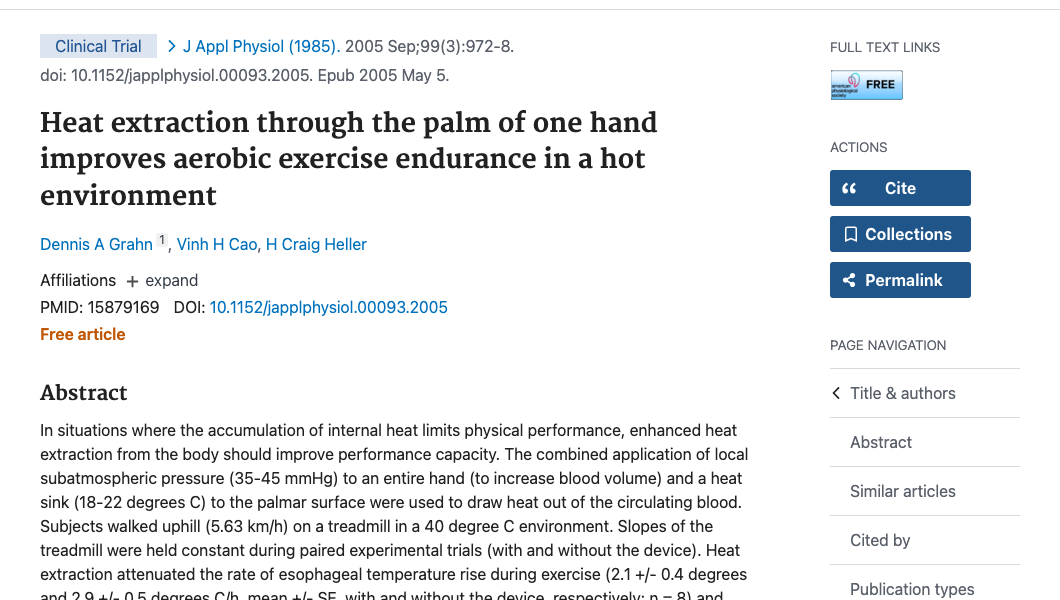
This Stanford study tested whether extracting heat through the palm could improve aerobic endurance in hot conditions. Subjects walked uphill on a treadmill at 5.63 km/h in a 40°C environment with and without a palm cooling device that applied mild subatmospheric pressure (35-45 mmHg) combined with a cold surface (18-22°C).
With palm cooling, subjects lasted 46.1 minutes vs 32.3 minutes without — a 43% improvement. Core temperature rise was significantly reduced (2.1 vs 2.9°C/h). The subatmospheric pressure was critical: cooling the hand alone without negative pressure provided minimal benefit, because the pressure is needed to keep blood flowing through the glabrous skin of the palm.
An 8-week follow-up with 9 subjects confirmed the benefit was consistent across sessions and workloads, with proportionally greater effects at lower exercise intensities.
Methods
- Paired trials with and without palm cooling device in 40°C environment
- Treadmill walking at 5.63 km/h on incline
- Core (esophageal) temperature continuously monitored
- n=18 for performance trials, n=8 for temperature measurement, n=6 for pressure comparison, n=9 for 8-week follow-up
Key Results
- Exercise duration: 46.1 ± 3.4 min (cooling) vs 32.3 ± 1.7 min (control)
- Core temp rise: 2.1 ± 0.4°C/h (cooling) vs 2.9 ± 0.5°C/h (control)
- Hand cooling without pressure: 34.1-38.0 min (minimal benefit)
- Hand cooling with pressure: 57.0 min
Limitations
- Hot environment (40°C) may not generalize to normal gym conditions
- Used proprietary device (not a DIY method)
- Aerobic walking protocol — unclear if results translate to other modalities