
Key Takeaway
Cooling glabrous skin (palms, soles, face) is highly effective at reducing core temperature in heat-stressed individuals, with additive effects when multiple surfaces are cooled simultaneously.
Summary
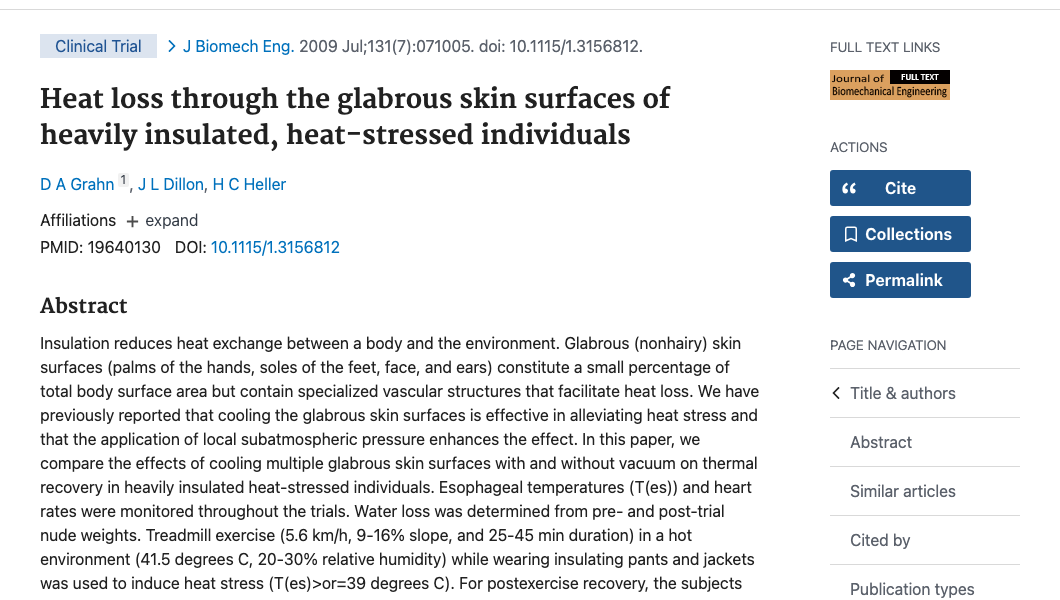
This foundational study from the Stanford palm cooling lab quantified heat extraction rates through glabrous (hairless) skin surfaces — the palms, soles of the feet, and face. These regions contain specialized blood vessels called arteriovenous anastomoses (AVAs) that allow rapid heat transfer between core blood and the environment.
Subjects exercised in 41.5°C heat wearing insulating gear until core temperature exceeded 39°C, then recovered for 60 minutes with various cooling treatments. Without cooling, temperature dropped 0.4°C/h. Cooling one hand achieved 0.8°C/h, and adding subatmospheric pressure improved it to 1.0°C/h. Cooling multiple glabrous surfaces was additive — face + feet + hands together achieved a 1.6°C drop.
The study clarified that subatmospheric pressure doesn't increase heat transfer per se, but maintains blood flow through the AVAs by preventing local vasoconstriction from the cold stimulus. This is why simply holding an ice cube doesn't work as well — the cold causes vasoconstriction, reducing blood flow and heat exchange.
Methods
- Heat stress induced via treadmill exercise (5.6 km/h, 9-16% slope) in 41.5°C environment
- Subjects wore insulating gear; exercised until esophageal temp ≥39°C
- 60-minute recovery with various cooling treatments to glabrous skin regions
- Conditions: no cooling, one hand, one hand + vacuum, multiple surfaces
Key Results
- No cooling: 0.4 ± 0.2°C/h recovery
- One hand cooling: 0.8 ± 0.3°C/h
- One hand + vacuum pressure: 1.0 ± 0.2°C/h
- Face + feet + hands: -1.6 ± 0.2°C total change
- Cooling effects from multiple glabrous surfaces are additive
Limitations
- Extreme heat stress conditions (41.5°C, insulating gear) may not generalize to normal exercise
- Recovery protocol only — did not test during exercise
- Small sample sizes per condition
