
Key Takeaway
Deep dry needling combined with stretching produces greater pain relief than stretching alone for myofascial trigger points.
Summary
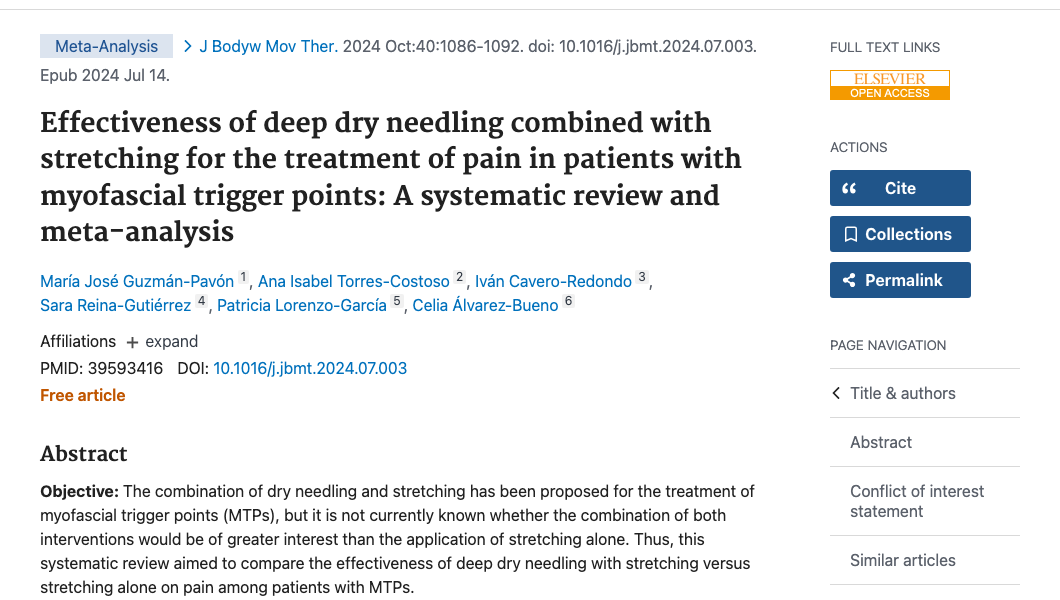
This systematic review and meta-analysis examined whether adding deep dry needling to stretching protocols improves pain outcomes in patients with myofascial trigger points compared to stretching alone. The authors searched PubMed, Web of Science, Cochrane Library, and Scopus databases for randomized controlled trials comparing the combination therapy against stretching-only controls.
Study quality was assessed using the Cochrane Risk of Bias 2 (RoB2) tool, and effect sizes were calculated using the DerSimonian-Laird random-effects method to account for heterogeneity across trials. The analysis focused on pain intensity as the primary outcome measure.
The findings indicate that the combination of deep dry needling with stretching is more effective than stretching alone for reducing pain in patients with myofascial trigger points. This supports the clinical practice of incorporating dry needling as an adjunct to stretching-based rehabilitation programs, particularly for patients with active trigger points that may not fully respond to stretching alone.
Methods
Systematic review and meta-analysis of RCTs. Searched PubMed, Web of Science, Cochrane Library, and Scopus. Included trials comparing deep dry needling plus stretching versus stretching alone in patients with myofascial trigger points. Risk of bias assessed using the Cochrane RoB2 tool. Effect sizes pooled using the DerSimonian-Laird random-effects model. Primary outcome was pain intensity.
Key Results
- Deep dry needling combined with stretching significantly reduced pain compared to stretching alone
- Effect sizes calculated using DerSimonian-Laird random-effects method showed favorable outcomes for the combination therapy
- Results support dry needling as an effective adjunct to stretching for myofascial trigger point treatment
Limitations
- Limited number of eligible RCTs in the literature
- Heterogeneity in dry needling protocols (number of sessions, needle insertion technique, dwell time)
- Stretching protocols varied across studies
- Most studies had relatively small sample sizes
- Long-term follow-up data was sparse across included trials
- Full text paywalled, limiting access to detailed subgroup analyses